Rural homes sit far from towers and behind hills, trees, and metal roofing, so indoor 5G often collapses to one bar. Here is how boosters, antennas, and a few free fixes actually recover that signal.
Why Is 5G Signal Weak in a Countryside Home?
Distance is usually the first thing working against you. Rural homes often sit miles from the nearest tower, and low-band frequencies like 700 MHz, 850 MHz, or 900 MHz can travel those long distances but don't carry much capacity. Meanwhile, the faster bands — 1800 MHz, 2100 MHz, 2600 MHz, and 3500 MHz — fade out well before they ever reach your kitchen. RootMetrics found that urban areas average roughly 80% better signal coverage than rural regions, and honestly, that tracks with what I notice comparing a city driveway to a farmhouse porch.
Then the building itself finishes the job. Metal roofing, brick, concrete, thick insulation, and energy-efficient windows all absorb or bounce back radio waves, and if the house has a big floor plan, whatever signal makes it through the walls gets spread thin across all that space. This isn't just a rural hunch, either. Industry surveys cited by SureCall, along with FCC reporting from 2021, estimate that somewhere around 25% to 30% of Americans deal with poor indoor coverage. Over in the UK, Ofcom data shows that 7% of the landmass gets no mobile coverage from any operator at all. So if your phone keeps dropping calls inside the house, there's a good chance it's not your imagination, and it's not just you.
The economics explain the gap. Ofcom points out that 15% of UK homes and businesses—rural ones especially—will be stuck with slow, pricey broadband for years, while the £1 billion Shared Rural Network aims to bring 4G to 95% of the UK by 2026. Until that build-out actually reaches your road, the practical fix is to capture the signal you already have outdoors and pull it inside.
How a 5G Signal Booster Works: Outdoor Antenna, Amplifier, Indoor Antenna
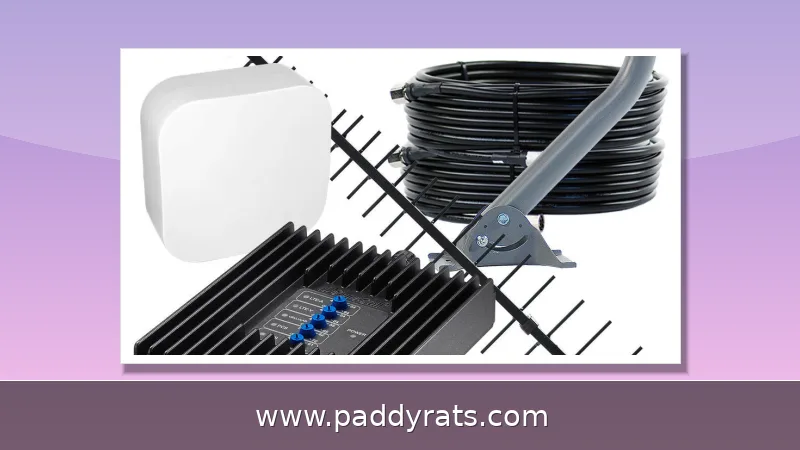
Think of a booster as a relay, not a signal source. An outdoor antenna pulls in whatever 4G or 5G signal is already there from the nearest tower, a coaxial cable runs that signal down to an amplifier that cranks it up, and then indoor antennas push the strengthened signal back out into your rooms. The uplink side works the same way but in reverse — your calls, texts, and uploads travel back up to the tower through the system. That's exactly why uplink power in dBm deserves just as much attention as raw gain when you're comparing specs.
When the signal outside is actually usable, the difference a booster makes can be pretty striking. Take that Rural East Texas home—a weBoost Home Complete took it from 1 bar at -116 dBm all the way up to 4 bars at -75 dBm. In another documented case, download speeds jumped from 9.45 Mb/sec to 30.2 Mb/sec, while uploads went from 0.11 Mb/sec to 6.19 Mb/sec. And then there's the Reddit user out in a rural area who was stuck with a marginal 1 bar, around -117 dBm, and got quoted $1,600 for a 5G unit rated for 15,000 sq ft.
The thing is, a booster amplifies noise just as eagerly as it amplifies signal. So if your outdoor reading is weaker than around -115 dBm, don't expect the thing to cover much more than a small corner of the house. The stronger the signal outside, the more coverage you'll get inside. That's why you should always measure outdoors first, before you spend a dime.
Choosing the Right Outdoor Antenna: Yagi vs Log-Periodic vs Omni
Antenna choice is what determines how much of that outdoor signal you can actually pull in, and the three common types each trade gain for forgiveness in different ways. A Yagi is directional and high gain, usually somewhere between 10 and 18 dBi, and Bolton's Quicksilver Outdoor Yagi claims it can reach towers up to 5 miles away. The catch is that it has to be aimed precisely; drift 15 degrees off target and the gain drops off quickly. A Log-Periodic lands at 7-12 dBi with a wider beamwidth, which is handy when two towers serve your area or your carrier switches bands. Then there's the Omni at 3-6 dBi, the easiest of the three to install since it needs no aiming at all, though it's better suited to urban rooftops and vehicles than to distant rural towers.
Real-world tuning backs this up. Take one Taobao DIY case: someone re-aimed a Yagi, tightened the mount, and swapped out a corroded SMA connector for a sealed N-Type joint. That alone pushed RSRP from -115 dBm up to -89 dBm and SINR from -5 dB to +12 dB — and they didn't add a single piece of new electronics.
Pull up CellMapper first and see which way the signal is actually coming from, then mount your antenna high on that side, away from trees and metal. If you're not sure which tower will be your long-term source, go with a Log-Periodic — its wider beam is the safer bet.
Gain, Uplink Power, and Coverage: What Specs Actually Matter
Gain works on a logarithmic scale, which is why a few decibels can hide a big difference in real-world performance. Every 3 dB you add doubles your power, so the 7 dB gap between a 72 dB booster and a 65 dB competitor actually works out to a little more than double the power. Uplink power matters too—it's basically how loudly your setup can talk back to the tower. A lot of competitors stop at 24 dBm, while Bolton's Victory goes up to 26 dBm. And whenever you see a coverage claim, don't take it at face value; check the gain number sitting right next to it.
Here's how the main options stack up on the numbers that actually matter when you're out in the country.
| Product | Gain | Uplink | Coverage |
|---|---|---|---|
| Bolton Victory | Up to 72 dB | Up to 26 dBm | Up to 4,000 sq ft |
| weBoost Home MultiRoom | Not published here | Not published here | Up to 5,000 sq ft |
| weBoost Home Complete | Not published here | Not published here | 1,500-10,000 sq ft typical |
| High-gain 5G unit | Up to 100 dB | Not published here | Up to 15,000 sq ft |
Typical home kits cover 1,500 to 10,000 sq ft, and a single high-gain unit can reach 15,000 sq ft with gain up to 100 dB. Pricing scales with that: HiBoost lists the Sidekick at $259.99, Hero at $369.99, 10K Smart Link at $539.99, 10K Plus Pro at $599.99, Travel 3.0 at $559.99, and 15K Smart Link Deluxe at $1,029.99. Lintratek's Quad Band CZ18A and KW20C 68dB sit in the budget tier, while CEL-FI, SureCall Fusion4Home and Fusion 5G, Wilson Pro IoT 5-Band, SignalBoosters, Waveform, and Frequency 3G Telecom round out the field.
Match the spec to your measured signal, not to the biggest number on the box. If your outdoor RSRP is around -100 dBm, a mid-range kit will cover a normal house; if it is -115 dBm, spend the money on antenna height and a low-loss cable run first.
Installation Tips: Antenna Placement, Cable Loss, and Avoiding Feedback
Placement beats specification. Use a phone or app to find the strongest outdoor spot, then mount the outdoor antenna high and clear of trees and metal. Keep the indoor and outdoor antennas at least 15 feet apart, because too little separation creates feedback that throttles the amplifier or shuts it down entirely.
Cable loss quietly destroys gain. Thin, long runs like RG-58 hurt performance, so use proper low-loss coax for anything beyond a short hop, seal every connector against water, and inspect for corrosion. That corroded SMA connector in the DIY case cost roughly 26 dB of RSRP before it was replaced with a sealed N-Type joint.
Aim a Yagi with a compass and recheck the reading after every adjustment, since a few degrees can matter. If you run a long cable, put the amplifier as close to the outdoor antenna as practical so the boosted signal travels the lossy distance indoors rather than outdoors.
Quick Fixes Before Buying a Booster: Wi-Fi Calling, Airplane Mode, Phone Settings
Free fixes come first, and sometimes they are enough. Move to a window or a higher floor, reduce interference from microwaves and cordless phones, and enable Wi-Fi calling, which is fast and free when your home broadband is strong but depends entirely on that connection holding up.
Phone settings matter more than most people expect. Toggling airplane mode forces the handset to reconnect to the nearest tower instead of clinging to a distant one. If your phone holds a weak 5G signal that keeps dropping, force LTE instead: on Android, go to Settings, then Network & Internet, then Mobile Network. Many rural users find a stable 4G LTE connection outperforms a marginal 5G one.
Remember that 85% of all mobile phone calls are made indoors, so these small adjustments affect most of your actual usage. If they still leave you at one bar, the data says a properly aimed booster with adequate outside signal is the next step.
Regulatory and Compliance: What You Can Legally Install
In the United States, the FCC requires all cellular boosters to be sold as complete kits, which is why reputable brands ship the outdoor antenna, amplifier, and indoor antenna together rather than as loose parts. Buying components separately and pairing them yourself can land you with a non-compliant setup.
In the UK, Ofcom passed the Wireless Telegraphy (Mobile Repeater) (Exemption) Regulations 2018 on 12 April 2018, permitting certain boosters without a licence: static indoor repeaters and low-gain in-vehicle repeaters that meet the technical standards. CEL-FI products are described as licence-exempt and compliant with Ofcom IR 2102 in the UK and ComReg S.I.No.283 of 2018 in Ireland.
For imported gear, check for NCC certification or your local equivalent. Unapproved active repeaters can interfere with carrier networks and get you shut down, so upgrading a passive external antenna on a certified indoor unit is often the safest DIY route, and it is exactly the change that produced the biggest gains in the cases above.
How does a 5G signal booster work in a rural home?
An outdoor antenna captures the existing weak 5G or 4G LTE signal from the nearest tower, coaxial cable carries it to an amplifier that strengthens it, and indoor antennas rebroadcast the boosted signal inside. The booster does not create signal; it amplifies what is already available outside, and the uplink path sends your calls back to the tower.
What outside signal strength do I need for a booster to work?
One rural booster discussion notes that if the outside signal is at least -115 dBm, you can cover a small area of your house, and the stronger the outside signal, the stronger the boosted indoor coverage. A real East Texas case moved from -116 dBm to -75 dBm after installation, which is a jump from 1 bar to 4 bars.
Which outdoor antenna should I choose for a countryside home?
A Yagi is a high-gain directional antenna, often 10-18 dBi, for a distant tower in one direction. A Log-Periodic offers moderate to high gain of 7-12 dBi with a wider beamwidth for multiple towers. An Omni is lower gain at 3-6 dBi and best for urban or mobile use, not for faint rural signals.
Why is my 5G signal weak inside my house?
Common causes include distance from cell towers, terrain such as hills and dense trees, and building materials like metal roofing, brick, concrete, thick insulation, and energy-efficient windows. Larger floor plans can weaken the signal further once it gets inside, which is why outdoor readings usually look far better than the bars on your phone.
Frequently Asked Questions
How does a 5G signal booster work in a rural home?
An outdoor antenna captures the existing weak 5G or 4G LTE signal from the nearest tower, coaxial cable carries it to an amplifier that strengthens it, and indoor antennas rebroadcast the boosted signal inside. The booster does not create signal; it amplifies what is already available outside, and the uplink path sends your calls back to the tower.
What outside signal strength do I need for a booster to work?
One rural booster discussion notes that if the outside signal is at least -115 dBm, you can cover a small area of your house, and the stronger the outside signal, the stronger the boosted indoor coverage. A real East Texas case moved from -116 dBm to -75 dBm after installation, which is a jump from 1 bar to 4 bars.
Which outdoor antenna should I choose for a countryside home?
A Yagi is a high-gain directional antenna, often 10-18 dBi, for a distant tower in one direction. A Log-Periodic offers moderate to high gain of 7-12 dBi with a wider beamwidth for multiple towers. An Omni is lower gain at 3-6 dBi and best for urban or mobile use, not for faint rural signals.
Why is my 5G signal weak inside my house?
Common causes include distance from cell towers, terrain such as hills and dense trees, and building materials like metal roofing, brick, concrete, thick insulation, and energy-efficient windows. Larger floor plans can weaken the signal further once it gets inside, which is why outdoor readings usually look far better than the bars on your phone.