Rural 5G and 4G LTE coverage fails for three predictable reasons: tower distance, terrain, and building materials. A properly aimed booster with a directional outdoor antenna is the most reliable fix, and it works with every major U.S. carrier.
Why Rural 5G and 4G Signal Is Weak
Urban cells are much more densely packed as well, meaning the rural cell has already died down by the time it reaches a farmhouse or shop at some long driveway. Distance accounts for part of the problem; terrain does the rest. The radio waves are blocked or scattered by hills, valleys, thick line of woods and heavy summer foliage long before they reach your property.
< p > Inside, it completes the work with building materials. Metal roofs, bricks or concrete walls, thick insulating materials and low-E windows efficiently attenuate cellular frequencies; whereas a sprawling floor plan distributes any signal that survives across more square footage. In practice, however, most rural households are battling a cocktail of distance and scale rather than an isolated factor based on the terrain or construction. That is important because the fix depends on which factor wins at your address.
How a Cell Phone Signal Booster Works
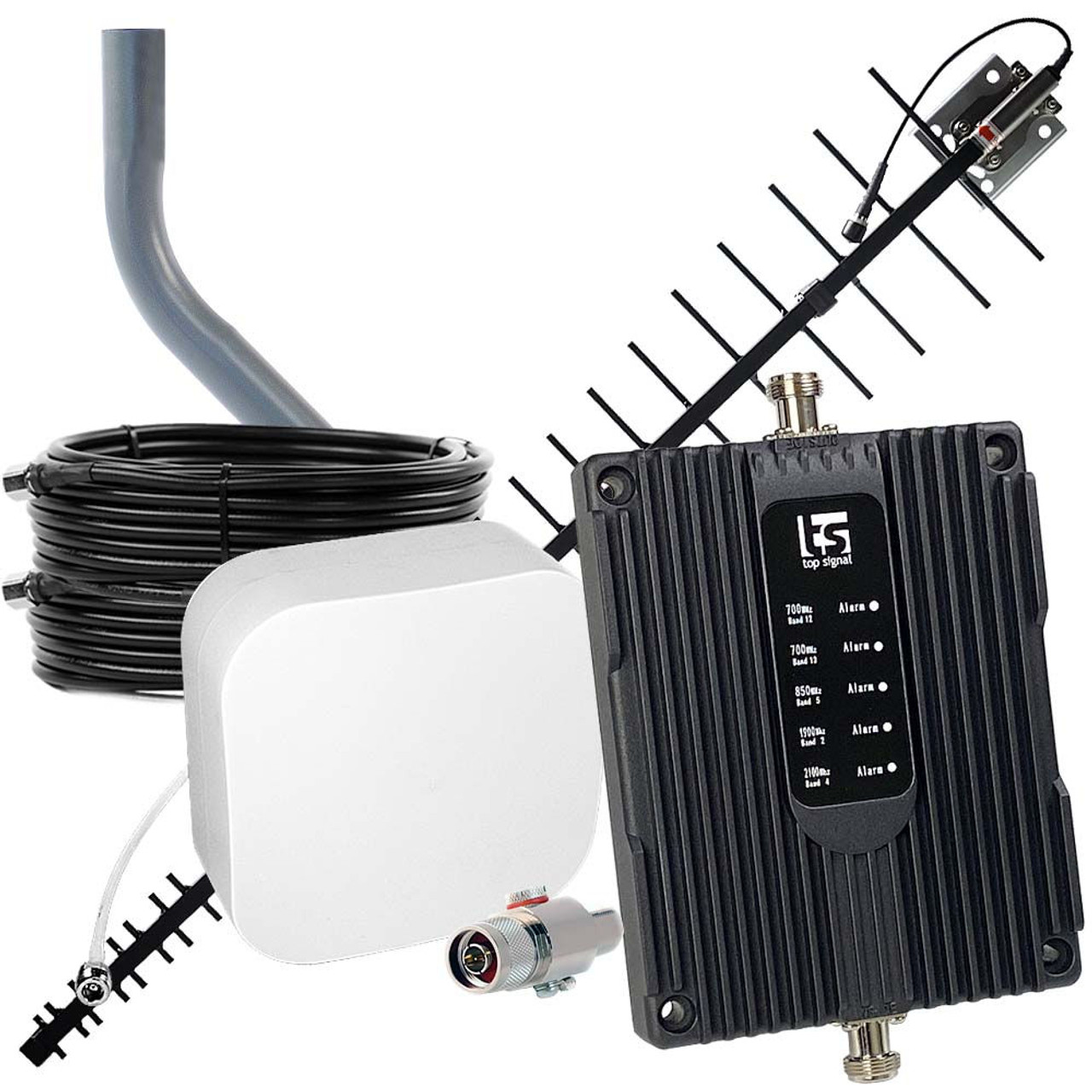
A booster is not creating signal – no product that claims to do this can be taken seriously. In essence, you already have a weak signal outside your home and this device captures it but amplifies that signal before rebroadcasting inside. It Runs in Four Steps In Months past, the outdoor antenna would pick up any present 4G or 5G signal, albeit at levels that a phone cannot utilize with consistency. Thence that signal is routed through coaxial cable into the building. Third, an amplifier strengthens it. 4) Indoor antennas amplify and retransmit the amplified signal where phones are used.
The result in practice is clearer calls, swifter data and fewer dropped connections. Since an outdoor antenna is able to be mounted high in the air and aimed accurately, it frequently can access a tower that simple handset might not hold on at all from inside a house. This is exactly why vantage point and target positioning far outweighs simply raw amplifier wattage in the case of a typical rural install.
Directional Antennas: Yagi, LPDA and Long Ranger
So, in rural areas be sure to go with a directional cellular antenna and stay away from omnidirectional models. Yagi, LPDA and Long Ranger designs concentrate their gain in the direction of your nearest cell tower; allowing you to pick up more usable signal over a longer distance. An omnidirectional antenna radiates its gain in all directions which is easy on a city level but inefficient if you only want the reception from one far away tower.
If you're setting up a rural system, the outdoor antenna matters more than anything else — go with a high-gain model and you'll be ahead of the game. That said, how much range you actually get varies a lot from one antenna to the next. The table below covers the trade-offs that come up most often in real installs.
How to Install a Rural Booster Step by Step
Set up is identical throughout all models. The first step is to carry a phone up there in field-test mode if feasible and walk around the property, eventually discovering where reception tends to be best — typically from the roof or high gable locations. Erect a mast as high as feasible, 10 to 15 feet is the target minimum height, then on that mount connect an outdoor antenna of sufficiently good gain directed at the next nearest tower. Hold the antenna as square on to the tower as you can — a few degrees of variance is paid for in real decibels.
Run coaxial cable from the outdoor antenna to amplifier, then place indoor antennas in areas most used. Wiring is usually the most difficult aspect of the job: coaxial cable, Wi-Fi ethernet and a window antenna feed may need to be routed where you plan to install your booster plus 110-volt power for it. Never drill anything without first planning that cable path and try to keep coax runs as short as your layout rule-set allows.
Booster Options for Rural Homes, Farms and Vehicles
Generally speaking, rural buyers have the option between home systems (which are typically more reliable), vehicle systems and single-carrier solutions. All weBoost boosters support 4G networks, and are designed to work with all major U.S. carriers—including Verizon, AT&T, T-Mobile Sprint™, and the UScellular network—and ensure compatibility for new emerging technologies like 5G. Stock prices below are book launch retail recommended prices at the time of writing and subject to change.
Cel-Fi G41: New single-carrier booster under FCC rules with more power than multi-carrier boosters It provides coverage of up to 3,000 square feet with a weak outside signal and as much as 15,000 sq feet for very strong signals using several inside antennas. The app provides signal metrics and an antenna aiming tool; directional, high-gain LPDA or parabolic grid outside antennas are available; supports up to four inside antennas. That little extra power is usually the trump card for anyone chasing maximum indoor coverage in a really weak place.
Does a 5G Signal Booster Really Work in Rural Areas?
Yes, provided usable signal exists somewhere outside the building. A 5G signal booster works when the local 5G signal operates on frequency bands the booster is designed to handle, which in rural America typically means low-band 5G spectrum. Low-band 5G travels farther and penetrates obstacles better than higher frequencies, which is exactly why carriers lean on it outside dense metro areas.
It helps to understand the trade-off between 5G and 4G LTE here. 5G nodes can transmit data over mmWave at higher data rates, but only across a small area, so mmWave is rare in rural settings. 4G LTE transmits over long distances, which is why 4G LTE continues to work alongside 5G and why most rural boosters are built around it first. A booster that supports both will keep working as carriers refarm spectrum.
Real-World Results: What a Rural Install Actually Delivers
Specifications only go so far, so here is a documented example. After installing a weBoost Home Complete in a rural East Texas home, in-home reception went from 1 bar to 4 bars, or roughly -116 dBm (near dead zone) to -75 dBm (great reception). The customer could then maintain calls with his daughter without standing in one corner of the house.
That swing, about 40 dBm, is consistent with what a well-aimed directional outdoor antenna and a quality amplifier can achieve when there is at least a whisper of signal outside. It also illustrates why field measurements beat marketing claims: the same equipment performs very differently depending on tower distance and antenna aim.
Phone Settings and Wi-Fi Calling as a Backup
Before or alongside a hardware purchase, tune the handset. Enable Wi-Fi calling under Settings, then Cellular, then Wi-Fi Calling, which routes calls over your internet connection when cellular coverage is marginal. If the device insists on holding a weak 5G signal, forcing LTE can improve stability, because a locked 4G LTE connection is often more reliable than a barely-there 5G one.
Other low-cost steps include moving to the part of the home with the best reception, reducing interference from nearby devices, and using Wi-Fi calling whenever it is available. For T-Mobile 5G specifically, a 5G hotspot with MIMO antennas is a current recommendation. Improving SINR is best done with a directional outdoor antenna, either connected to a signal booster or wired directly to an LTE or 5G hotspot.
Frequently Asked Questions
Why is my 5G signal so weak in a rural area?
Rural cell towers are spread much farther apart, so signal weakens over distance before reaching your home. Hills, trees, valleys and dense foliage block or scatter it, and metal roofing, brick, concrete, thick insulation and energy-efficient windows block it indoors. Usually it is a combination of distance, terrain and building materials rather than one single cause.
Does a 5G signal booster really work in a rural area?
Yes, if usable signal exists outside. A booster does not create signal; it captures existing 5G or 4G LTE with an outdoor antenna, amplifies it, and rebroadcasts it indoors. It works when the local 5G runs on frequency bands the booster supports, and it also continues to work with 4G LTE, which carries most rural traffic.
What antenna should I use to boost rural 5G signal?
Directional antennas are strongly recommended in rural areas. Yagi, LPDA and Long Ranger antennas focus on the nearest cell tower to capture more signal from greater distance. A high-gain outdoor antenna, mounted high and aimed at the tower, gives the best results and is usually the single biggest upgrade you can make.
How do I install a rural signal booster?
Find where reception is best, usually on the roof, and mount a mast at least 10 to 15 ft high. Install a high-gain outdoor antenna facing the nearest tower, run coaxial cable to the amplifier, then place indoor antennas where you use your phone most. Plan the cable path early, since routing coax, Ethernet and power is the hardest part.