A jammer that transmits over a band of frequencies simultaneously is known as barrage jamming. It trades power density on any single channel for wide coverage, which is why it is the go-to technique against frequency-hopping drones and other FHSS links.
What Is a Jammer That Transmits Over a Band of Frequencies Simultaneously?
When a jammer transmits across a whole range of frequencies at once, that's called barrage jamming. Rather than putting all its power on a single narrow channel, one transmitter spreads its energy over a wide slice of spectrum simultaneously, which means multiple channels get degraded at the same time. In electronic warfare, jamming refers to the deliberate transmission of RF signals to disrupt, degrade, or deny use of a communications channel, radar, or navigation system — and it falls under the electronic attack category (IEEE).
It sounds straightforward in theory, but pulling it off well is another matter. Barrage jamming means a single jammer is hitting multiple frequencies at the same time, and the catch is that its power gets spread thin across all of them — so it ends up comparatively weaker at any one frequency (JEM Engineering). You're basically trading depth for breadth: the wider the band you try to cover, the less energy you can actually put on each individual channel.
Terminology in this field overlaps a lot, so it's worth sorting out the synonyms early. Barrage jamming also goes by broadband noise jamming, constant jamming, or wideband jamming, and you'll see all of these used pretty much interchangeably. A few related terms tend to come up alongside it too: spot jamming, sweep jamming, reactive jamming, protocol jamming, DRFM (digital radio frequency memory), deceptive jammer, J/S ratio, burn-through, ECCM, FHSS, and spread spectrum. One thing worth clearing up, though, is that jamming techniques split broadly into two families—noise jamming and repeater jamming—and noise jamming is the one that works by laying broadband or narrowband noise over the target band (IEEE).
Barrage Jamming vs Spot Jamming vs Sweep Jamming
The three classic noise-jamming strategies mostly come down to how each one spreads its power across frequency and time. Spot jamming throws everything onto a single frequency, which gives you the highest power density and works well against fixed-frequency links — but it's useless against frequency-agile radar. Sweep jamming takes that same full power and moves it back and forth across a range of frequencies, so it can hit several of them in quick succession. It just can't hit them all at once.
Barrage jamming throws interference across a wide swath of frequencies all at once, which lets it cover more ground, though each individual channel gets less power (ScienceInsights). So the real trade-off comes down to how many frequencies you can disrupt versus how hard you can hit each one. Protocol jamming works on a completely different principle. Instead of blanketing the whole band, it's a smarter approach that goes after specific data packets, and because it's so targeted, it needs far less power and causes minimal collateral interference.
Here's a quick comparison of how each approach stacks up against different types of targets.
| Technique | Power Allocation | Best Against | Weakness |
|---|---|---|---|
| Spot jamming | All power on one frequency | Fixed-frequency links | Ineffective against frequency-agile radar |
| Sweep jamming | Full power moved across a range | Multiple frequencies in sequence | Cannot hit all frequencies at once |
| Barrage jamming | Spread across a wide band at once | Frequency-hopping drones (FHSS) | Needs immense power to stay effective band-wide |
| Protocol jamming | Low power, packet-targeted | Specific data packets | Requires knowledge of the protocol |
So here's the bottom line: barrage jamming is about covering ground, not hitting a bullseye. If you already know the exact channel the target is sitting on, spot jamming will do the job with far less wasted power. But when the target is hopping around a band in a pattern you can't predict, your only real shot is to blanket the whole range at once and hope you keep up.
How Barrage Jamming Works: J/S Ratio and Receiver Burn-Through
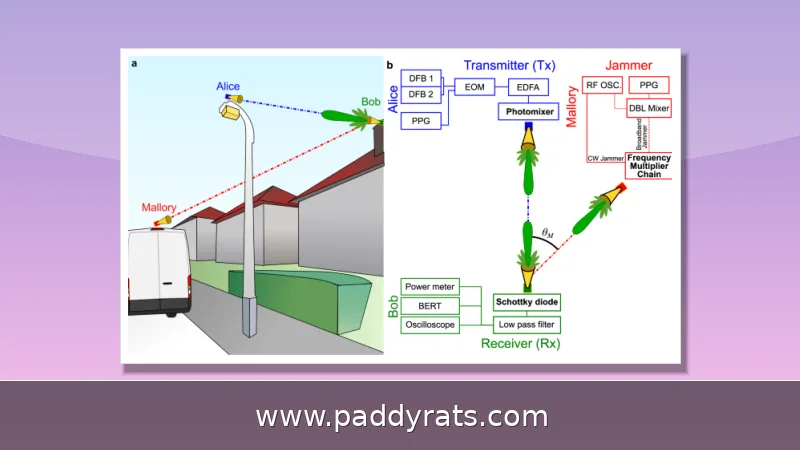
A jammer is basically a transmitter tuned to the same band the target is using. It broadcasts a stronger signal on the frequency that target is listening to, and that's what keeps the receiver from telling the real signal apart from the noise (Startup Defense). Whether it works comes down to the Jamming-to-Signal (J/S) ratio, meaning how much power the jamming signal has compared to the legitimate signal at the victim receiver. Once that ratio pushes past the receiver's burn-through threshold, the link is gone (Sentrycs).
RF Wireless World lays out that J/S equation with all the variables spelled out: J/S = (Pj * Gjr * Grj * Rtr^2 * Lr * Br) / (Pt * Gtr * Grt * Rjr^2 * Lj * Bj). Here Pj stands for jammer power, Pt for transmitter power, Br for the communications receiver's bandwidth, Bj for the jamming transmitter's bandwidth, and Rjr for the distance between the jammer and the receiver. The part worth pausing on is that jamming bandwidth shows up in the denominator — so every time you stretch the barrage band wider, you're watering down the ratio unless you compensate by pumping in more power.
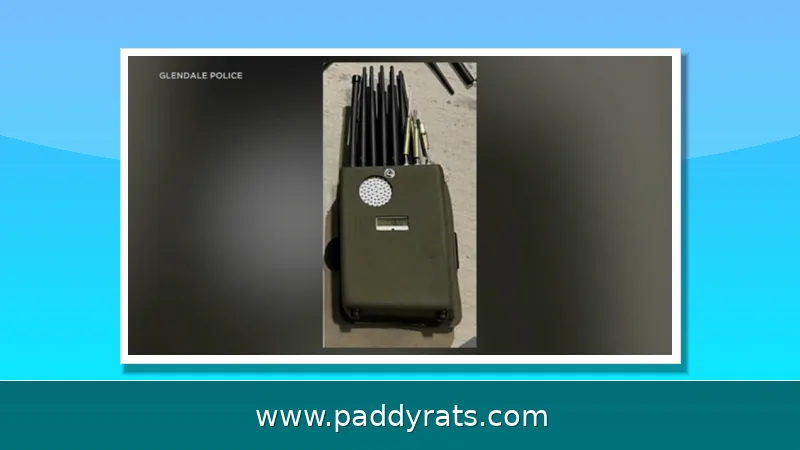
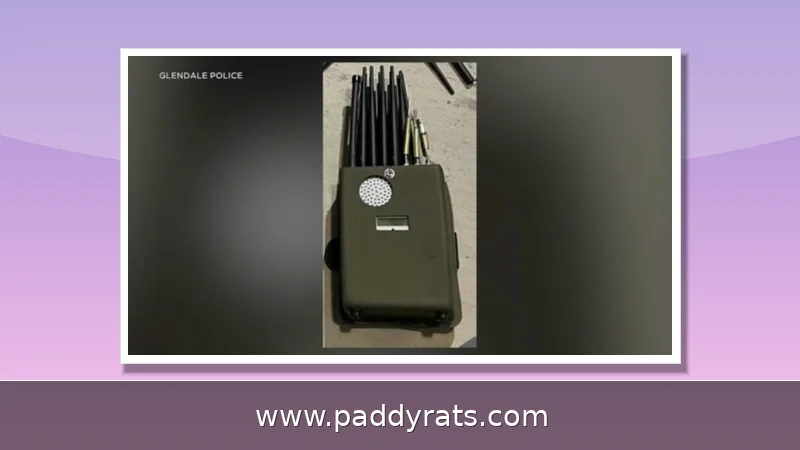
That math leads to three basic design rules. First, the jammer's frequency should match the receiving station's frequency. Second, the modulation type has to match too. And third, the jammer's power needs to be higher than that of the station it's trying to disrupt (RF Wireless World). If you look at a block diagram of a mobile jammer, it usually breaks down into a power supply, an IF section with a VCO that's tuned by a reference oscillator, and an RF section made up of an RF upconverter, an RF power amplifier, and an antenna. Strip it down to the essentials, though, and every jammer comes down to four core parts: a power source, an oscillator, an amplifier, and an antenna (ScienceInsights).
Patent US3896439A is an early take on this idea. Filed in 1955 and published in 1975, it covers a multi-spot radar jamming system built around a broadband noise source that gets split into several output channels. Switches route those channels to broadband transmitting means, and a broadband receiver flips the switches in response to whatever signals it picks up. The whole thing scans every frequency across its wide band at once, using a short lookthrough period. That's basically a blueprint for the kind of wideband behavior barrage jamming depends on today.
Why Barrage Jamming Targets Frequency-Hopping Drones and FHSS Links
Frequency-hopping spread spectrum (FHSS) drones switch channels rapidly, so a narrowband jammer cannot follow them. Barrage jamming covers a wide band simultaneously, so it can block frequency-hopping links such as drone control and video downlinks on bands like 2.4 GHz and 5.8 GHz (Sentrycs). That is the central reason counter-drone systems lean on wideband noise rather than precision spot techniques.
Drone links commonly operate at 433 MHz, 900 MHz, 1.2 GHz, 1.5 GHz, 2.4 GHz, and 5.8 GHz, and counter-drone jammers typically target up to 6 GHz. Handheld rifle-shaped models reach about 2 km, while tower- or vehicle-mounted automated systems cover 4 to 10 km with output power between 240 and 800 watts, with some monitoring a full 360-degree field. Those power figures exist precisely because barrage coverage demands far more output than a single-channel attack.
On the research side, a cognitive non-coherent jamming testbed described in arXiv:2505.07429v1, published May 12, 2025 by Universita degli Studi di Napoli Federico II, acquires signals from 70 MHz to 6 GHz with instantaneous bandwidth up to 20 MHz. That kind of wide acquisition window is what makes adaptive, frequency-selective attacks possible against hopping targets.
Named jammer manufacturers active in this space include SESP Group, Enterprise Control Systems Ltd in the UK, WolvesFleet Technology Co., Ltd., and HSS Development in New York. Their product lines reflect the same engineering reality: wide instantaneous bandwidth plus enough amplifier power to keep J/S above burn-through across the whole covered band.
Trade-Offs, Limitations and Collateral Interference
The headline limitation is power. Barrage jamming requires immense power output to remain effective over the whole bandwidth, because every hertz you add to the barrage spreads the same amplifier output thinner. That is why wideband systems are bulky, hot, and power-hungry compared with a narrowband spot jammer that can achieve the same J/S on one channel with a fraction of the wattage.
Collateral interference is the second cost. Because barrage jamming is indiscriminate by design, it can degrade friendly and civilian links operating in the same band, including Wi-Fi at 2.4 GHz, 5 GHz, and 6 GHz, and GNSS receivers around 1575 MHz (L1, E1, E5a designations). GPS satellite signals reach the ground at roughly negative 120 dBm, which is faint enough that even modest wideband noise can swamp them.
Deployment scale varies widely. Small low-power jammers cover a single room, and about three or four low-power units can cover roughly 400 square meters. Medium-power jammers around 10 to 20 watts per frequency module cover 1,000 square meters or more with one or two units. Portable RF jammers commonly run across four to eight bands simultaneously.
Market data reflects steady demand: the VHF/UHF band holds about 30.81% of jammer sales, and the overall market is expanding at a compound annual rate of roughly 8.70%. Consumer jammer pricing runs roughly forty to a thousand US dollars depending on power. Cellular jammer bands span roughly 700 MHz to 2600 MHz, with 2G/3G around 800-900 MHz and 1700-2100 MHz, 4G LTE about 700 MHz to 2600 MHz, and 5G mid-band at 3300-3800 MHz plus millimeter-wave at 24,000-29,500 MHz.
Regulation, Enforcement and Anti-Jam Countermeasures
In the United States, the Communications Act of 1934 and 47 U.S.C. 302a(b) prohibit operating, making, marketing, selling, importing, distributing, or shipping jammers, except for authorized federal agencies such as DoD, DOJ, DHS, and DOE. Unauthorized jamming is a federal crime, and enforcement actions have included substantial fines against retailers and operators alike. Similar restrictions exist in most other jurisdictions, which is why legitimate jamming activity is confined to government and military users.
On the defensive side, ECCM (electronic counter-countermeasures) is the umbrella term for techniques that resist jamming. FHSS and other spread-spectrum schemes are themselves anti-jam measures, since they force a jammer to cover more bandwidth. Burn-through margin, antenna nulling, and waveform agility all raise the J/S a jammer must achieve before a link actually fails.
Reactive and protocol-aware jamming represent the next step in the cat-and-mouse cycle. Rather than flooding a band continuously, these approaches listen first and transmit only when a target is active, which conserves power and reduces collateral damage. DRFM-based deceptive jammers go further by replaying altered copies of a radar pulse so the victim sees false targets instead of obvious noise.
For anyone evaluating counter-drone or RF security gear, the practical checklist is straightforward: confirm the covered bands match the threat, verify output power per band rather than total power, check whether the system is reactive or constant, and confirm the legal basis for operation. Wideband coverage without adequate power per channel is a specification sheet that will not hold up in the field.
Frequently Asked Questions
What is a jammer that transmits over a band of frequencies simultaneously called?
It is called barrage jamming. A single jammer spreads its energy across a wide band of frequencies at the same time, disrupting several channels at once. Because power is divided across the whole band, it is less powerful on any single frequency than spot jamming, which concentrates all output on one channel.
How is barrage jamming different from spot and sweep jamming?
Spot jamming concentrates all power on one frequency. Sweep jamming shifts full power from one frequency to another in quick succession, but not all at once. Barrage jamming transmits across many frequencies simultaneously, trading power density per channel for wide frequency coverage, which is what makes it useful against hopping targets.
Why is barrage jamming used against frequency-hopping drones?
Frequency-hopping spread spectrum (FHSS) drones switch channels rapidly, so a narrowband jammer cannot follow them. Barrage jamming covers a wide band simultaneously, so it can block frequency-hopping links such as drone control and video downlinks on bands like 2.4 GHz and 5.8 GHz, keeping the J/S ratio above burn-through.
Is it legal to operate an RF jammer?
In the United States, the Communications Act of 1934 and 47 U.S.C. 302a(b) prohibit operating, making, marketing, selling, importing, distributing, or shipping jammers, except for authorized federal agencies such as DoD, DOJ, DHS, and DOE. Unauthorized jamming is a federal crime, and similar restrictions apply in most other countries.