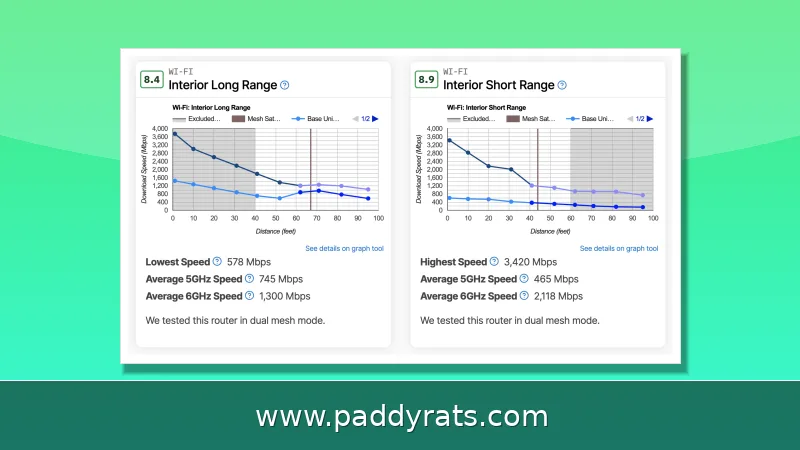
WiFi 6 rarely delivers dramatically longer range than WiFi 5, but it wins on speed, latency, and crowded-network performance. Here is what real-world tests actually show and when an upgrade pays off.
What Is the Real Difference Between WiFi 5 and WiFi 6 Range?
WiFi 5 (802.11ac) came out back in 2014, and it only runs on the 5 GHz band. That's a real limitation, since 5 GHz doesn't travel as far or push through walls as well as 2.4 GHz does. WiFi 6 (802.11ax), on the other hand, didn't become widely available until late 2019, and it works on both 2.4 GHz and 5 GHz. So if you're far from the router, your device can drop down to the slower but farther-reaching band. That dual-band flexibility, more than any boost in transmit power, is really why WiFi 6 can feel like it covers more of your home.
One published comparison puts WiFi 5's maximum range at around 20 to 25 meters, with WiFi 6 reaching about 45 meters — but that's under ideal conditions, which is doing a lot of work in that sentence. In the real world, how far your signal actually travels comes down to transmit power limits, antenna design, what your walls are made of, and how much interference is floating around. A technical discussion over on the LTT forum didn't sugarcoat it: you're not really going to see a range difference going from WiFi 5 to WiFi 6, since WiFi 6 runs on 2.4 GHz at roughly the same level as WiFi 4.
Honestly, WiFi 6 gives you somewhat better *usable* coverage—not some massive jump in raw distance. The real win is how it deals with interference and congestion: far-off devices stay connected at speeds you can actually use instead of constantly dropping. That said, if you're trying to fix one dead corner behind three plaster walls, adding a mesh node or a wired access point will do way more for you than just moving up a WiFi generation.
WiFi 6 vs WiFi 5 Speed: Real-World Test Results
Spec sheets can be misleading here. Yes, WiFi 5 tops out around 3.5 Gbps theoretical and WiFi 6 goes up to 9.6 Gbps, but your actual devices are never hitting those numbers. What actually matters is the realistic throughput a 2x2 MIMO laptop or phone can pull on a standard channel width. On an 80 MHz channel, a WiFi 6 client usually maxes out around 900 Mbps, give or take 100, compared to roughly 650 Mbps plus or minus 60 on WiFi 5.
In a head-to-head test, WiFi 6 pulled down around 970 Mbps compared to 650 Mbps on WiFi 5, and upload speeds told a similar story. Push things further and the gap gets even wider — one real-world measurement logged 1.95 Gbps of throughput from an Intel AX210 client talking to a TP-Link Archer AX80 on the 5 GHz band over a 160 MHz channel, though a more typical result on that same channel width is 1.5+ Gbps. For businesses making the switch, the payoff tends to land in the 30 to 40 percent range for speed improvements.
| Metric | WiFi 5 (802.11ac) | WiFi 6 (802.11ax) |
|---|---|---|
| Released | 2014 | Late 2019 |
| Max theoretical speed | ~3.5 Gbps | Up to 9.6 Gbps |
| Bands | 5 GHz only | 2.4 GHz and 5 GHz |
| Real-world download (test) | ~650 Mbps | ~970 Mbps |
| Typical 80 MHz client | ~650 Mbps +/-60 | ~900 Mbps +/-100 |
| MU-MIMO | 4x4 downlink | 8x8 uplink and downlink |
| Security | WPA2 | WPA3 |
One thing to keep in mind when you look at that table: the real-world download number comes from a pretty favorable test setup, so don't treat it as a promise. What you actually get depends on your internet plan, the radio in your client device, the channel width, and how many neighbors are all broadcasting on the same channel. And if your broadband tops out at 300 Mbps, both generations will max it out without breaking a sweat, which means the speed gap basically vanishes in everyday use.
Why WiFi 6 Uses 2.4 GHz and 5 GHz for Better Coverage
The 2.4 GHz band reaches farther and pushes through walls better, while 5 GHz gives you faster speeds as long as you're not too far from the router. WiFi 5 only operates on 5 GHz, which means a device sitting at the edge of your coverage is stuck with either a weak connection or no connection at all. WiFi 6 fixes that by letting devices scan both bands and switch between them automatically — far-off devices get steered to 2.4 GHz, while anything close by stays on 5 GHz.
That band steering is exactly why WiFi 6 coverage often feels better in practice, even when the raw range isn't all that different. Say your phone is out in the backyard—instead of dropping the network completely, it can fall back to 2.4 GHz and hold on at 40 to 80 Mbps. Not blazing fast, but it keeps you connected. The catch is that 2.4 GHz is a pretty crowded space, with microwaves, baby monitors, and Bluetooth all competing for room, so throughput there tends to stay on the modest side.
Intel's own docs on 2.4 GHz vs. 5 GHz say pretty much the same thing: the lower band is all about reach and punching through walls, while the higher band is where you get your speed. So if you want both, your router has to be good at moving devices between the two bands without you ever noticing. That's one place where WiFi 6 just does a better job than WiFi 5.
How OFDMA and MU-MIMO Improve Performance in Busy Networks
WiFi 5 can only serve one device at a time on a given channel, so in a house packed with phones, laptops, and smart plugs, everything has to wait its turn. WiFi 6 changes that with OFDMA (Orthogonal Frequency Division Multiple Access), which carves a single channel into smaller resource units so several devices can be served at once. When your network is crowded, that scheduling upgrade ends up mattering far more than whatever peak speed is printed on the box.
MU-MIMO also improved. WiFi 5 Wave 2 handled up to four devices simultaneously and only when sending data downlink. WiFi 6 doubles that to eight devices and adds two-way communication, so uplink traffic benefits too. Two other features round out the picture: BSS Coloring reduces interference from neighboring networks in dense apartment buildings, and TWT (Target Wake Time) lets phones, tablets, and IoT devices sleep longer between transmissions to save battery.
The practical result is lower latency and fewer stalls during peak hours. If your evening video calls stutter while someone else streams 4K, that is a contention problem, and it is exactly what WiFi 6 was designed to fix. WiFi 5 can still struggle in that scenario even when the signal bars look full.
WiFi 6 vs WiFi 5: Specs, Security, and Latency Compared
Beyond speed, the generational gap shows up in security and responsiveness. WiFi 6 supports WPA3, which adds stronger handshake protection and better resistance to offline password guessing, while WiFi 5 relies on WPA2. For anyone running a home office or handling sensitive work traffic, that alone can justify the move.
Latency is the other quiet win. OFDMA and better scheduling cut the queuing delay that shows up as lag in gaming and video conferencing. WiFi 6 also uses 1024-QAM, packing more bits per symbol than WiFi 5's 256-QAM, which raises throughput on clean channels. Device density is the third factor: WiFi 6 was explicitly designed for high device counts, and WiFi 5 can struggle once dozens of clients compete for airtime.
Compatibility is not a concern. WiFi is backward compatible, so a WiFi 6 router will happily connect older phones and laptops. You only get the full benefit when both the router and the client device support WiFi 6, which is worth checking before you spend money on a new access point.
Should You Upgrade to WiFi 6 or Skip to WiFi 7?
Upgrade guidance comes down to how you actually use the network. Households with 10 or more devices, 4K streaming, gaming, or remote work see a real difference with WiFi 6. WiFi 5 still works fine for light use with five or fewer devices, especially if your internet plan is under 300 Mbps. Choose WiFi 6 if you have 500 Mbps or faster internet, many devices, latency-sensitive needs, or you want better future-proofing and security.
The pricing math has shifted in your favor. Most new routers sold today are WiFi 6 compatible, often at price points similar to older WiFi 5 models, so the upgrade premium has largely evaporated. That makes WiFi 6 the default choice rather than a luxury one.
The bigger question now is whether to skip straight to WiFi 7. WiFi 7 (802.11be) is widely available with prices that have dropped, and it is the fastest option at up to 46 Gbps. If you are buying a router you plan to keep for five years and your devices are recent, jumping to WiFi 7 can make sense. Otherwise, WiFi 6 remains the value pick. This article is not investment advice.
What Are the Risks and Limitations of Real-World WiFi 6 Range Tests?
Real-world results depend heavily on equipment and environment, so treat any single test as a data point rather than a promise. Router marketing advertises aggregate Gbps figures that sum across bands and streams; what matters is the realistic speed your client devices can achieve, often a 2x2 MIMO limit for a single band. The router spec sheet rarely reflects your living room.
Here is the uncomfortable truth: virtually all routers of the same WiFi generation have the same maximum PHY speed to a 2x2 MIMO client device. The real differentiator is performance at distance, DFS channel behavior, MIMO implementation, contention handling, and interference at your specific location. Home size, wall materials, and the number of connected devices shape the experience, especially during peak hours.
That is why two people can buy the same router and report opposite results. Before upgrading, measure your current throughput at the far end of your home, note how many devices are active at once, and check whether your bottleneck is the router or the internet plan. Fixing the actual bottleneck beats buying a new generation on hope.
Frequently Asked Questions
Does WiFi 6 actually have longer range than WiFi 5 in real-world use?
WiFi 6 can offer slightly better range because it uses both 2.4 GHz and 5 GHz, while WiFi 5 relies on 5 GHz. The 2.4 GHz band travels farther and penetrates walls better. One comparison lists max range of 20 to 25 meters for WiFi 5 versus 45 meters for WiFi 6, though real results depend on equipment and environment.
How much faster is WiFi 6 than WiFi 5 in real-world speed tests?
Theoretical peaks are about 3.5 Gbps for WiFi 5 and 9.6 Gbps for WiFi 6. In one head-to-head test, WiFi 6 hit around 970 Mbps download versus 650 Mbps on WiFi 5. Another source reports businesses upgrading to WiFi 6 tend to see a 30 to 40 percent speed improvement.
Is WiFi 6 worth upgrading to if I have many devices?
WiFi 6 is built for dense environments using OFDMA and improved MU-MIMO, serving multiple devices simultaneously instead of one at a time per channel. Sources suggest households with 10 or more devices, 4K streaming, gaming, or remote work see a real difference, while WiFi 5 still works for light use with five or fewer devices.
Will I see a range difference going from WiFi 5 to WiFi 6?
One technical discussion states you are not really going to see a range difference going from WiFi 5 to WiFi 6, because WiFi 6 devices use the 2.4 GHz band in a way roughly on par with WiFi 4. Other sources say WiFi 6 offers slightly better range and fewer dead zones due to better interference handling.