A passive long range WiFi antenna does not create power, it reshapes it. Here is how Yagi, panel, parabolic grid, and omnidirectional designs actually perform when you are pulling a distant signal into a rural property.
What Does a Long Range WiFi Antenna Do for Rural Reception?
A passive antenna doesn't generate RF power on its own, and it won't repeat traffic either. What it actually does is reshape how the radio's existing energy gets radiated and received. That's why you can swap out a stock dipole for a properly aimed directional antenna and pick up real range without ever touching the radio's output. With rural reception, though, you're usually stuck with the tougher end of the deal: the access point or fixed wireless tower sits miles away, the path runs through trees or over a rise, and your client radio still has to pull in a weak signal and transmit back.
That last point is where a lot of people get tripped up. A high-gain antenna can't fix a badly placed access point, a blocked path, an overly long coax run, or a low-power client that can't transmit back. Receiving a signal is a two-way conversation. If your antenna can hear the tower but your radio can't answer it, you'll see a strong signal reading and still get no usable connection. Rural setups live or die on that symmetry, so I always plan out the return path before I buy any hardware.
Directional antennas concentrate all their energy into one direction, which also helps block out interference from the sides and behind the beam. Omnidirectional antennas, on the other hand, spread their signal 360 degrees horizontally, but that vertical pattern is never truly spherical—as gain goes up, the vertical beam gets narrower and narrower. That trade-off basically defines everything in rural reception, and it's exactly why the same 15 dBi antenna might work great out on a flat farm field but be completely useless on a hillside where clients are scattered above and below the mast.
Directional vs Omnidirectional: Which Antenna Wins at Distance?
If you're trying to pull in one far-off access point, a directional antenna is almost always the better call. A Yagi, a panel, or a parabolic grid focuses your energy toward the target and tunes out noise coming from the sides, which is why they consistently beat stock dipoles and omni antennas when you already know where the signal is coming from. So if your rural reception headache is a single tower, or a neighbor's AP a mile down the road, just aim at it and stop browsing for alternatives.
Omnidirectional antennas make sense when you're trying to cover a bunch of devices close by, not when you're trying to reach something far away. The big advantage is that you don't have to aim them, which is a real plus if your mast is somewhere you can't easily get back to. But realistically, you're looking at about a mile of range, and that's only under perfect conditions. RadioLabs says its 15 dB omni antenna paired with o2Surf radios can handle rural WiFi access beyond 5 miles without much trouble, and they've even had reports of ranges over 10 miles. Still, those setups are engineered links with clean paths and proper elevation, not some router sitting in a kitchen window.
Realistically, most rural setups end up needing both. You'd use a directional link to pull the signal in from wherever it's coming from, then hand it off to an omnidirectional or sector antenna that spreads it across the yard, barn, and outbuildings. That combination isn't some kind of compromise, either. It's actually the smartest way to keep from throwing coverage behind the installation while still getting a usable signal to the far edge of your property.
Yagi, Panel, and Parabolic Grid Antennas Compared
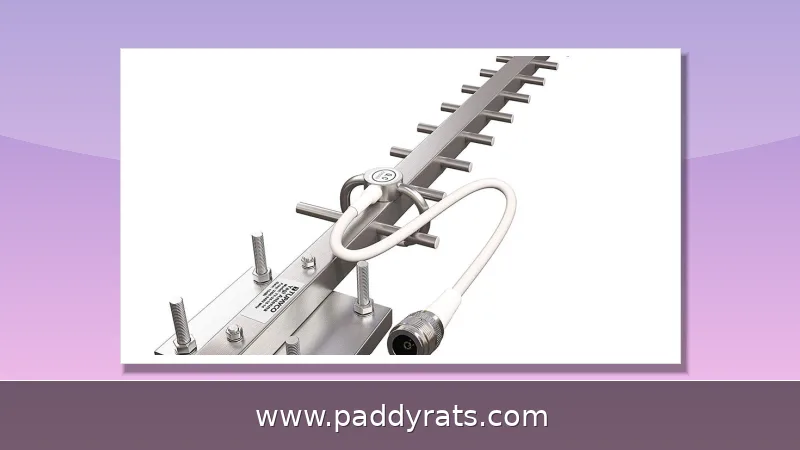
Every directional antenna solves a slightly different problem, and the differences come down to gain, how forgiving the aiming is, and how much of the signal path you can afford to have blocked. A Yagi uses a driven element along with reflector and director elements, usually topping out around 12 dBi, and it has to be aimed carefully because the beam gets narrower as gain goes up. Take the Mobile Mark Yag12-5500: depending on how it's configured, it puts out anywhere from 4 to 50 dBi of gain and is rated for 25 Watts, which is way more than you'd ever need for a rural reception setup.
Panel antennas are the forgiving choice. They typically offer somewhere between 9 dBi and 19 dBi, and they put up with imperfect aiming much better than a Yagi does, which makes them a solid pick for indoor signal boosts and building-to-building links. Take the Alfa APA-M25: it's a 10 dBi directional panel built for indoor WiFi boosts. Then there's the RadioLabs 19 dB Panel, a 2.4 GHz 2x2 MIMO weatherproof commercial-grade unit that delivers 19 dB of gain on both transmit and receive. Parabolic grids, on the other hand, give you very high gain and demand very precise alignment, plus you need a clear line of sight. One catch is that the feedhorn shadow can pull down receive gain, so a solid panel can actually outperform a grid when it comes to reception.
Here's how all three stack up on the specs that actually matter for pulling in a signal out in the country.
Key Specs: Frequency, Gain, Beamwidth, and Transmit Power
| Antenna Type | Typical Gain | Aiming Tolerance | Best Use |
|---|---|---|---|
| Yagi | Up to 12 dBi | Precise | Single distant AP or tower |
| Panel | 9-19 dBi | Forgiving | Building-to-building, indoor boost |
| Parabolic grid | Very high | Very precise | Long clear line-of-sight links |
| Omnidirectional | Up to ~15 dBi | None needed | Many nearby devices, ~1 mile |
A powerful long-range WiFi antenna should put out roughly 30 dBm of transmit power with about 20 dBi of gain, but that's not the number you should chase if you're trying to pull in a distant signal. For receiving, the realistic sweet spot is 9 dBi to 20 dBi of gain on a directional antenna. More gain isn't automatically better, either. You have to read gain and beamwidth as a pair, since any extra gain has to come out of the beam somewhere, and that's usually the vertical plane. Get too aggressive and you end up with a razor-thin vertical pattern that completely misses clients sitting above or below your aim point.
Frequency choice matters just as much. Lower frequencies travel longer distances, so 2.4 GHz antennas are better for long-distance data transfer. Most modern long-range equipment uses 5 GHz for significantly greater throughput and less congestion, and the shorter 5 GHz range is compensated by deploying equipment at elevation where there are no physical obstacles. Dual-band antennas operate on both 2.4 GHz and 5.8 GHz; some switch between bands, others use both simultaneously.
There is also a US regulatory hinge at 6 dBi. Above it, fixed 2.4 GHz point-to-point links must give back 1 dB of radio power for every 3 dB of extra antenna gain, while fixed 5.725-5.850 GHz links do not. That single rule changes the math on a high-gain 2.4 GHz build, and it is worth checking before you assume a bigger antenna means more legal power.
How to Plan a Rural Link: Coverage Shape, Cable Loss, and Alignment
Start with the shape of the coverage area, not the catalog. Mark the access point and the devices it must serve on a simple sketch, then choose the band with numbers rather than habit. Subtract cable loss before you compare antenna gain figures, because LMR-400 loses about 22.2 dB per 100 m at 2500 MHz and 35.5 dB per 100 m at 5800 MHz. A 10 m run can quietly erase 2 to 4 dB of the gain you paid for, which is exactly the margin that decides whether a rural link works.
Check path clearance and line of sight next. Fresnel clearance, not just a visual sightline, is what keeps a link stable through weather and foliage. Then confirm environmental sealing. An IP68 radome does not make an IP68 antenna system, and outdoor failures usually start at the connector, so seal the N-Female joint and strain-relieve the coax. Finally, confirm the equipment has a usable external antenna port. Many consumer routers use fixed internal antennas or proprietary connectors, which ends the project before it starts.
A practical order of operations: sketch coverage, pick the band, read gain with beamwidth, subtract cable loss, verify clearance, seal the connector, and only then buy hardware. RadioLabs' 15 dB omni is a good example of hardware built for this reality, a thin-wall fiberglass commercial series with a CNC machined aluminum hub, N-Female coax connector, and anodized aluminum and stainless steel hardware that survived 7 hours of Hurricane Florence winds in September 2018.
Real-World Range Expectations and Common Installation Mistakes
Omnidirectional long range antennas are effective for around 1 mile in perfect conditions. Directional point-to-point links can reach several miles with a clear unobstructed line of sight, and integrated long-range kits claim ranges up to 7 miles. Wireless internet itself could technically achieve 50 to 100 kilometers with the right hardware, but those are one-way links not intended for endpoints, so treat the headline number as a laboratory ceiling rather than a shopping target.
The SignalBooster kit illustrates what a packaged product looks like: 2.4 GHz 802.11 b/g/n, radio power up to 28 dBm, antenna gain 5 dB, range up to 7 miles, throughput 100+ Mbps, and a 25 ft wire. On the higher end, the LigoPTP RapidFire 5 reaches throughputs up to 700 Mbps using 256QAM and W-Jet technologies, which shows how much of long-range performance is now a radio and modulation story, not just an antenna story.
Common failures repeat themselves. People choose excessive gain and send energy above or below the devices. They use an omni antenna and waste coverage behind the installation. They specify only one end of a two-way link. They assume one narrow high-gain antenna can cover widely separated clients. They mount on plastic or in a shielded position without checking performance. Every one of those mistakes is cheaper to fix on paper than on a mast in January.
Rural use cases are broader than people expect: backyards, garages, attics, barns, workshops, detached buildings, farms, and yards. Point-to-point WiFi antenna systems can reach up to 1 mile to pull in signal. A Reddit user configured a Ubiquiti Rocket with an 8 dBi antenna into a router to broadcast a long range WiFi network across a farm, and DIY builds using two AX3000 outdoor wireless access points are described as doable with basic tools and no IT background. That is the realistic bar for most rural reception projects in 2026: a clear plan, honest cable math, and hardware aimed at one job.
Frequently Asked Questions
What is the best type of antenna for long range WiFi reception in rural areas?
A directional model such as a Yagi, panel, or parabolic grid paired with high gain and correct alignment works best. Directional designs focus energy in one direction and reject off-axis noise, so they outperform stock dipoles and omnidirectional antennas when reaching a distant access point. A panel is the most forgiving choice if you cannot aim precisely.
How far can a long range WiFi antenna actually reach?
Omnidirectional long range antennas are effective for around 1 mile in perfect conditions. Directional point-to-point links can reach several miles with a clear unobstructed line of sight, and integrated long-range kits claim ranges up to 7 miles. Wireless internet itself could technically achieve 50 to 100 kilometers with the right hardware, though those are one-way links not intended for endpoints.
Should I choose 2.4 GHz or 5 GHz for rural WiFi reception?
Lower frequencies travel longer distances, so 2.4 GHz antennas are better for long-distance data transfer. However, most modern long-range equipment uses 5 GHz for greater throughput and less congestion. The shorter 5 GHz range is compensated by mounting equipment at elevation where obstacles are reduced, and dual-band antennas can use both bands simultaneously.
Why does cable loss matter when installing an outdoor WiFi antenna?
LMR-400 loses about 22.2 dB per 100 m at 2500 MHz and 35.5 dB per 100 m at 5800 MHz, so a 10 m run can quietly erase 2 to 4 dB of the gain you paid for. Subtract cable loss before comparing antenna gain numbers, and keep the coax run as short as the mast allows.