Wideband frequency hopping spreads a signal across many narrow sub-channels using a pseudorandom sequence, so a jammer can only touch a small fraction of hops. Here is how the WFH navigation signal structure works, what processing gain buys you, and where barrage and follower jammers still bite.
What Is Wideband Frequency Hopping and Why Is It Used for Anti-Jamming?
Wideband frequency hopping (WFH) grabs a big chunk of spectrum, splits it into a bunch of narrow sub-channels, and then jumps the carrier between them at high speed, all driven by a pseudorandom code. Since the transmitter and receiver are both working from that same code, they stay perfectly in sync — while anyone listening in without the key just hears noise-like bursts. That's the basic idea behind a 2026 paper by C. Wang in IET Radar, Sonar & Navigation, which proposes a navigation signal structure built on wideband frequency hopping modulation, with the goal of boosting antijamming performance.
The anti-jamming logic here is really just simple arithmetic. A narrowband jammer can only occupy the sub-channels that fall inside its own bandwidth, so it knocks out a small slice of the hops while everything else gets through untouched. The receiver then throws away those corrupted hops and reconstructs the message from the ones that survived. That's the basic idea behind frequency hopping spread spectrum (FHSS), and it explains why regulators favor FHSS in crowded ISM bands, where interference would otherwise be a constant problem.
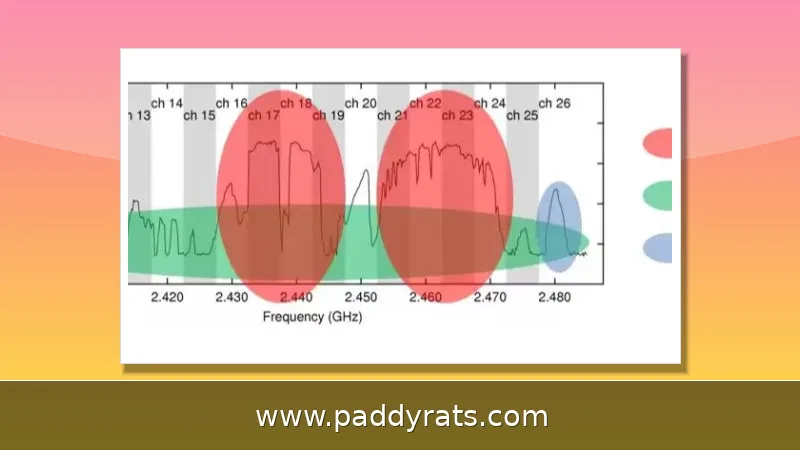
I've spent years staring at waterfall displays of hopper signals, and honestly, the picture says it better than any block diagram ever could. Three overlapping hoppers show up as dashed lines sprinting across the band, while a spot jammer is nothing more than a single bright vertical stripe—and most of those dashes just step right around it.
How Does the WFH Navigation Signal Structure Work?
The WFH navigation signal structure comes down to four pieces that all have to work together: channelization, hopping sequence, synchronization, and dwell time. Channelization is what splits the wide band into a bunch of narrow sub-channels. The hopping sequence is a pseudorandom algorithm that sets the order in which those sub-channels get visited—and that's exactly what keeps an unauthorized listener from predicting the pattern or syncing up to it. Synchronization is the part where the transmitter and receiver switch carrier frequencies in a pre-determined order at the same instant, and dwell time is simply how long the signal sits on one frequency before it hops to the next.
Catching these signals is tough for a couple of reasons. For one, the energy is scattered across the entire hopping band, so no single channel ever looks strong. On top of that, the transmit power can be kept low enough that the signal just blends into the background noise. But even with all that working in its favor, anyone trying to piece the waveform back together still needs a long list of details: how long each hop lasts, the hop length, the bandwidth in use, the center frequency, how many channels are involved, and exactly which frequencies are being used.
Overlapping hoppers make things even messier. When several of them collide in frequency or in time, a detection system might flag hits that aren't real or miss ones that are — a well-known headache in crowded spectrum environments. That's where forward error correction (FEC) comes in to clean things up. It can recover the occasional jammed hop, and around 10% jamming is usually no problem to correct. But once jamming climbs to 30–50% of hops, you'll need a stronger FEC code with a lower code rate, and that eats directly into your throughput.
Slow Versus Fast Frequency Hopping: Key Differences
What separates slow hopping from fast hopping comes down to the ratio between the symbol duration (TS) and the hop time (TH). With slow hopping, TS is larger than TH, so several symbols ride on the same carrier before the signal moves on. Fast hopping flips that relationship: TS/TH is greater than one, meaning a single data bit gets spread across multiple hops, and the hop time ends up shorter than the symbol duration. In practice, slow hop dwell times tend to sit in the millisecond range, while fast hopping drives dwell times below 100 microseconds.
The trade-off here is pretty stark. Slow hopping is easier to follow and intercept since the carrier hangs around longer, but it's also simpler to synchronize and plays nicely with coherent detection. Fast hopping, on the other hand, is extremely hard to track in real time, which is why it typically gets paired with non-coherent modulation schemes like FSK and MFSK. To keep FSK tones orthogonal, the minimum distance between them needs to equal multiples of the hop frequency fH.
In reality, it's tough to keep coherent detection working reliably once you're fast hopping, so non-coherent detection ends up being the standard approach. Adaptive frequency hopping (AFH) takes a completely different tack: rather than trying to outrun the jammer, it just sidesteps noisy or jammed channels and weaves around the interference. That's exactly why Bluetooth built it in.
Processing Gain and Jammer Strategies: Spot, Follower, and Barrage
Processing gain is basically the number that tells you how much of an edge frequency hopping gives you over a jammer. It comes from the ratio of the total hopping bandwidth to the bandwidth of a single hop, plugged into a log scale: PG = 10 × log10(W / B_hop). Run the math with a 200 MHz hopping band and a 25 kHz hop, and you land at roughly 39 dB. In plain terms, that means a jammer would need to be about 39 dB stronger just to take out every hop.
The math here turns brutal for the jammer pretty quickly. Take a spot jammer, which only hits a narrow slice of the band — say 1 MHz out of 100 MHz. That works out to just 1% of hops getting jammed, which is basically nothing. A barrage jammer tries to cover the whole band at once, but then its power gets spread thin across every hop channel, diluted by the ratio B_hop / W. Run the numbers for a 100 MHz band with 25 kHz hops and you're looking at roughly 36 dB of dilution. That's a huge penalty to swallow just to keep up.
The follower jammer is the more elegant threat. It must detect the hop, retune, and transmit inside the dwell time; if it cannot react within T_hop, it misses the hop entirely. Against fast hopping that deadline is brutal. The table below summarizes how each strategy fares.
Real-World Systems: Bluetooth AFH and SINCGARS Hopping Patterns
Two fielded systems show how the theory lands in hardware. Bluetooth uses adaptive frequency hopping across 79 channels in the 2.4 GHz ISM band, with 1,600 hops per second, 1 MHz channel spacing, and transmit power from 1 mW to 100 mW depending on Class 1-3. The hopping is fast enough to shrug off narrowband interference, and AFH lets it blacklist channels occupied by Wi-Fi.
SINCGARS is the military counterpart, hopping across 2,320 channels in the 30-88 MHz VHF band at more than 100 hops per second. Its pattern is generated by a COMSEC module using a classified algorithm and a shared crypto key, yielding roughly 2^128 possible patterns. Without the key, an adversary cannot follow the sequence even with perfect signal detection.
Reactive jamming has caught up on the research side. Patent US10985861B2, filed by Drexel University on 2019-02-25 and granted 2021-04-20, describes a software-defined radio apparatus with an FPGA hardware IP core for time-sensitive jamming of FHSS signals; its example targets a 1 MHz signal on a detected Bluetooth channel. On the defense side, Liang et al. (2024, arXiv:2407.13361) explored mode hopping (MH) for radio vortex communications, using OAM mode orthogonality so that MH within a narrow frequency band achieves the same bit error rate as conventional wideband FH, with mode-frequency hopping (MFH) cutting BER further. Bandwidth hopping spread spectrum (BHSS), proposed by Liechti et al. in 2015, is another attempt to improve jamming resistance by hopping bandwidth rather than only frequency.
Strengths, Limitations, and Synchronization Requirements
The strengths of frequency hopping are well documented: jamming resistance, low probability of intercept, and resilience to multipath. Those benefits come with real costs. Synchronization is the fragile point. If the receiver loses sync with the hopping sequence, the link does not degrade gracefully; it fails completely, because every hop lands on the wrong frequency.
Barrage jamming remains the blunt but effective counter when the attacker can afford the power. Spectrum congestion is the quieter problem: FHSS is widespread in ISM bands precisely because regulators mandate it to prevent interference, and when Wi-Fi, Bluetooth, and other hoppers share the same air, collisions rise. Jamming those signals often requires wideband emissions that spill onto other spectrum users, which is a regulatory problem as much as an engineering one.
The table below puts the main trade-offs side by side.
How Fast Hopping and FEC Work Together Against Jammers
Fast hopping and forward error correction are complementary, not redundant. Hopping reduces how much of the message a jammer can touch; FEC repairs the hops that do get hit. With fast hopping, multiple hops carry one symbol, so losing a few hops costs only a fraction of the symbol energy, and the code can still recover the bit. This is why fast FH is usually paired with non-coherent FSK or MFSK rather than coherent schemes.
The design budget is unforgiving. Barrage jamming against FH is extremely power-expensive: to reach J/S = 10 dB per hop with a 100 MHz band and 25 kHz hops, a barrage jammer needs about 46 dB more power than a spot jammer. That number is the reason wideband hopping survives in contested spectrum, and it is also why attackers prefer reactive and follower approaches that spend power only when a hop is present.
For anyone designing or evaluating a WFH navigation signal, the practical checklist is short: pick hop bandwidth to maximize processing gain, keep dwell short enough to outrun follower jammers, choose FEC strength against the expected jammed-hop percentage, and treat synchronization as the single point of failure it is.
Key Parameters at a Glance
The specifications below are the ones I check first when comparing hopping schemes, because they determine both anti-jam margin and implementation complexity.
| Parameter | Typical Value | Effect |
|---|---|---|
| Slow hop dwell time | Milliseconds | Easier sync, easier to intercept |
| Fast hop dwell time | Under 100 microseconds | Hard to track, needs non-coherent detection |
| Processing gain | 10 x log10(W / B_hop) | 200 MHz band, 25 kHz hop gives about 39 dB |
| Narrowband jammer coverage | B_jam / W | 1 MHz in 100 MHz jams about 1% of hops |
| Barrage power dilution | B_hop / W | 100 MHz band, 25 kHz hop gives about 36 dB |
| Bluetooth AFH | 79 channels, 1,600 hops/s | 2.4 GHz ISM, 1 MHz spacing |
| SINCGARS | 2,320 channels, 100+ hops/s | 30-88 MHz VHF, about 2^128 patterns |
Read the table as a budget. Processing gain tells you how much jammer power the waveform can absorb; the jammer coverage and dilution rows tell you what the attacker must spend to get through; and the two real-world rows show that these numbers are achievable in shipping products, not just in papers.
Frequently Asked Questions
How does wideband frequency hopping resist jamming?
The carrier rapidly switches across many sub-channels using a pseudorandom sequence shared by the transmitter and receiver. A narrowband jammer only affects the fraction of hops that fall inside its bandwidth, so the receiver discards the jammed hops and reconstructs the message from the clean ones. This is the core mechanism behind frequency hopping spread spectrum.
What is the difference between slow and fast frequency hopping?
In slow hopping, multiple symbols are transmitted per hop and the symbol duration exceeds the hop time. In fast hopping, multiple hops carry one symbol, so hop time is shorter than symbol duration. Fast hopping is far harder to jam or intercept in real time, but it generally requires non-coherent detection such as FSK or MFSK.
What is the anti-jam processing gain of frequency hopping?
Processing gain equals 10 times log10 of the total hopping bandwidth divided by the instantaneous hop bandwidth. For a 200 MHz hopping band and a 25 kHz hop bandwidth, the gain is about 39 dB, which means a jammer must be roughly 39 dB stronger to block every hop instead of only a small fraction.
Why is barrage jamming inefficient against frequency hopping?
A barrage jammer spreads its power across the entire hopping band, so power per hop channel is diluted by the ratio of hop bandwidth to total bandwidth. For a 100 MHz band and 25 kHz hops, that dilution is about 36 dB, which forces the attacker to field enormous jammer power compared with a spot or follower approach.