Sidelobe cancellation (SLC) uses small auxiliary antennas to adaptively subtract jamming that sneaks into a radar through its sidelobes, restoring target detection. Here is how it works, what limits its 20-40 dB cancellation ratio, and how it differs from adaptive beamforming.
What Is Sidelobe Cancellation in Radar Anti-Jamming?
Sidelobe cancellation is one of the fundamental electronic counter-countermeasures, or ECCM, for keeping a radar up and running while someone is actively trying to jam it. The concept itself is pretty narrow: a jammer doesn't have to sit in the radar's main beam to cause trouble. It can dump energy into the antenna's sidelobes — those off-axis responses that typically run about 15 to 25 dB below the main lobe peak — and still flood the receiver with noise. SLC goes after that specific path.
The way I've come to understand it from reading through the radar literature, the clearest description is that it works like a spatial filter—one that figures out where the interference is coming from and then puts a steerable null right in that direction. What's nice about this approach is that the main antenna pattern stays exactly as it is, and the target beam doesn't get moved around at all. Instead, a separate adaptive path handles the subtraction of the unwanted signal, which means the target echo makes it through while the jammer gets knocked down.
This technique has been showing up on military radars since the 1960s, which says a lot about how well the underlying concept holds up. It's still the go-to ECCM method for legacy rotating dish radars, mainly because you can retrofit it without swapping out the whole antenna or rebuilding the beamforming setup from scratch.
How Does the Sidelobe Cancellation Technique Work?
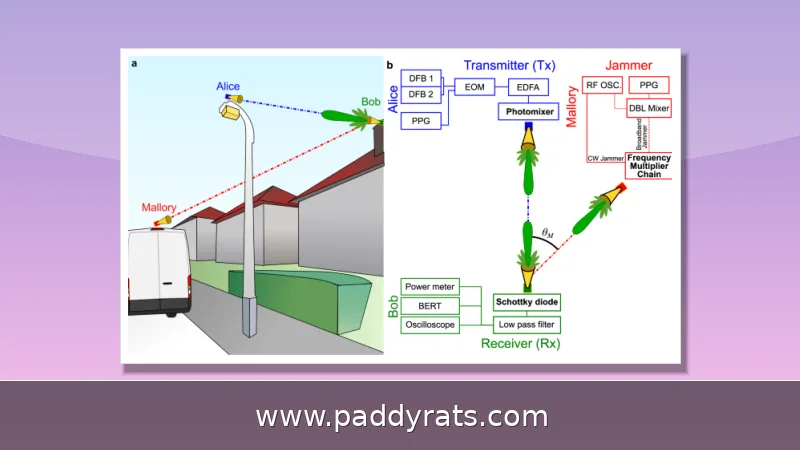
On the hardware side, everything begins with the auxiliary antennas—small, low-gain elements positioned around the main radar antenna. Each one is designed so that its gain sits at roughly the same level as the main antenna's sidelobes, or just a touch above. That match is what makes the whole scheme work: it lets the auxiliary pick up essentially the same jammer signal that's leaking in through the main antenna's sidelobes, while staying blind to the target echo, since the target return is concentrated in the main beam.
The processor then figures out a set of adaptive weights and applies them to the auxiliary signals, subtracting that result from the main signal. Put simply, the output equals the main channel minus the weighted sum of the auxiliary channels: y = x_main − Σ w_k · x_aux_k. Those weights aren't arbitrary — they're derived by minimizing the output power, but with one key constraint: the main beam gain has to stay intact. Do that, and the correlated interference gets cancelled out, while the uncorrelated target signal passes through untouched.
Each auxiliary antenna can cancel one independent jammer source, which means a system with two or four auxiliaries can handle that many threats at once. In spatial terms, what you get is a steerable null that automatically points itself at the jamming source. The earliest design relied on a single control loop that steered one null against one jammer; Howells and Applebaum later extended this into a multiple-loop design capable of handling several jammers simultaneously.
What Limits Sidelobe Cancellation Performance?
Cancellation ratio — the improvement in signal-to-jammer ratio — usually lands somewhere in the 20–40 dB range. That figure is real, but it's a best-case ceiling rather than something you can count on, and a handful of physical effects will pull actual performance below it. The biggest culprit is auxiliary antenna pattern mismatch: when the auxiliary doesn't pick up exactly the same jamming signal that's coming through the main antenna's sidelobe, the subtraction isn't clean, and whatever jamming is left over sticks around as residual interference.
Pattern mismatch by itself usually keeps cancellation in the 25–35 dB range. Bandwidth mismatch adds a second problem: when the jammer's bandwidth is wider than the cancellation loop's, cancellation starts to fall off at frequency offsets. Then there's internal noise in the auxiliary receiver, which sets a floor on how much cancellation you can actually get—you can't subtract below your own noise level. Multipath is the fourth issue. If the jammer signal reaches the radar through several paths with different delays, a single-tap cancellation loop just isn't enough to handle it.
One more caveat that's worth calling out at the system level: if the adaptation isn't constrained carefully, adaptive sidelobe cancellation algorithms can distort the beam, shift where the main lobe points, and ultimately hurt target detection. So the constraint that preserves main beam gain isn't just a nice refinement you can tack on later—it's a fundamental part of how the design has to work.
A 2023 study found that a sidelobe cancellation jamming strategy, when used against noise jamming, improved the suppression ratio by 28.75 dB and cut range power by 6.95%. Similarly, a 2026 SPIE study confirmed that the proposed sidelobe cancellation algorithms deliver effective anti-jamming performance under both narrowband and broadband conditions. It's worth noting that these numbers fall within the range you'd expect from the technique — they don't exceed what the performance envelope predicts.
SLC vs Adaptive Beamforming: Key Differences
The comparison that comes up most often is SLC versus adaptive beamforming. Both go after the same kinds of problems, but the hardware behind them looks nothing alike. SLC relies on a handful of auxiliary antennas—usually two to four—to cancel specific jammers while the main antenna pattern stays put, which means the main beam's direction and shape never change. Adaptive beamforming, on the other hand, uses the entire array to place nulls. That approach can distort the main beam, and it demands a phased array with element-level digital receivers.
The trade-off is straightforward. SLC is simpler, cheaper, and can be retrofitted to existing radars, which is why it dominates on legacy rotating dish systems. Adaptive beamforming is more capable and more flexible, but it demands a modern array architecture and more processing. Neither is universally better; the choice follows the platform and the threat.
It is also worth separating SLC from sidelobe blanking. SLB is a well-established technique for cancelling intentional or unintentional impulsive interference such as false targets. The two are complementary rather than competing, and a mature ECCM suite may use both.
The table below summarizes the practical differences across the main parameters.
Can SLC Handle Main Beam Jamming?
No. SLC is designed to cancel sidelobe jamming only, and this is the single most important limitation to understand. If the jammer is in the main beam direction, its signal is far stronger in the main channel than in the auxiliary channels. Subtracting it would require removing so much energy that the target echo would be cancelled along with it, defeating the purpose.
Main beam jamming needs different tools: adaptive beamforming, sidelobe blanking, or burn-through. Burn-through range is the distance at which the target echo finally rises above the jamming, and it is a function of radar power, antenna gain, and jammer strength rather than of the cancellation loop.
In practice, a radar designer treats sidelobe jamming and main beam jamming as separate problems with separate countermeasures. SLC buys you back the sidelobe case at modest cost; the main beam case is where the expensive architecture decisions live.
History and Inventors of the Sidelobe Canceller
Paul Howells is credited with inventing the sidelobe canceller, covered by US Patent 3,202,990. Sid Applebaum is credited with the mathematical analysis and the extension of the concept to adaptive arrays. Both originally worked for General Electric's Heavy Military Electronics Department in Syracuse, and later at the Special Projects Lab of SURC, the Syracuse University Research Corporation.
Dean Chapman, an IEEE Senior Life Member, contributed a first-hand account of this work on ETHW, which is a useful reminder that much of the early adaptive-array theory came out of defense research rather than academia. On the patent side, Raytheon Co holds US6538597B1, covering a spoofer, blanker and canceler, with Fritz Steudel as inventor.
One application of particular interest to SURC was ballistic missile defense; the ABM radar problem was a driver of the early work. Sidelobe cancellation was later extended to AEW, or airborne early warning, applications, where the platform constraints and clutter environment create their own challenges.
The table below lists the key milestones and attributions for reference.
Design and Implementation Considerations
If you are specifying or evaluating an SLC subsystem, the engineering checklist matters as much as the theory. Confirm specifications against application requirements before finalizing the design. Account for environmental factors: temperature range, humidity, and vibration affect long-term reliability and parameter drift, and a cancellation loop that drifts out of alignment loses dB quickly.
Evaluate cost versus performance honestly. The question is whether the application demands premium components or standard commercial grades, and that answer depends on the threat environment and the platform's service life. Verify interface compatibility as well: impedance, connector type, and mechanical form factor must match the system architecture. Finally, include sufficient design margin for manufacturing tolerances and aging effects.
None of this is glamorous, but in my experience the difference between a 30 dB system and a 25 dB system is usually integration discipline rather than the adaptive algorithm itself.
Frequently Asked Questions About Sidelobe Cancellation
Readers tend to arrive with a small set of recurring questions about how SLC behaves in the field. The answers below cover the mechanism, the performance ceiling, the comparison with adaptive beamforming, and the main beam limitation.
The short version is that SLC is a mature, well-understood ECCM technique with a predictable performance envelope, and knowing that envelope is what lets you deploy it correctly.
Frequently Asked Questions
How does sidelobe cancellation work in radar anti-jamming?
Sidelobe cancellation uses one or more small, low-gain auxiliary antennas placed around the main radar antenna. Each auxiliary receives roughly the same jammer signal as the main antenna's sidelobes but not the target echo. The processor computes adaptive weights and subtracts the auxiliary signals from the main signal, cancelling correlated jamming while preserving the target.
What is the typical cancellation ratio of sidelobe cancellation?
The cancellation ratio, meaning the improvement in signal-to-jammer ratio, is typically 20-40 dB. It is limited by the match between main and auxiliary antenna patterns at the jammer direction, the bandwidth of the cancellation loop, and the correlation between jammer signals in the main and auxiliary channels.
How is SLC different from adaptive beamforming?
SLC uses a small number of auxiliary antennas, typically 2-4, to cancel specific jammers while the main antenna pattern stays fixed, so main beam direction and shape are unaffected. Adaptive beamforming uses the full array to form nulls, which can affect the main beam shape and requires element-level digital receivers.
Can sidelobe cancellation protect against main beam jamming?
No. SLC is designed to cancel sidelobe jamming only. If the jammer is in the main beam direction, its signal is much stronger in the main channel than in the auxiliary channels, and SLC cannot subtract it without also cancelling the target. Main beam jamming needs adaptive beamforming, sidelobe blanking, or burn-through.