An RFID blocking sleeve wraps your passport or tap-to-pay card in a thin metallic Faraday cage that stops 13.56 MHz signals cold. Here is how the shielding actually works, what it costs, and when it is worth buying.
What Is an RFID Blocking Sleeve and What Does It Protect?
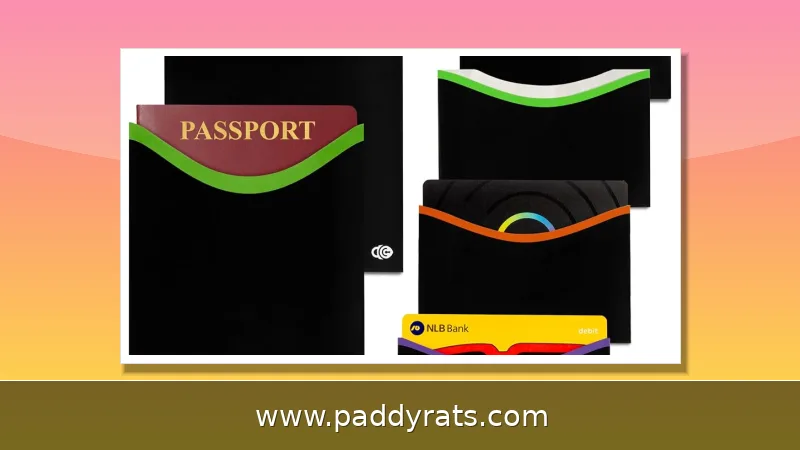
An RFID blocking sleeve is basically a thin paper or fabric envelope with a metallic foil or laminate lining. Slip a contactless credit card, debit card, smart ID, or e-passport inside, and that lining wraps around it in a conductive layer that stops radio waves from getting through. Here's the catch: the sleeve only shields whatever's physically inside it. That's the entire point, but it's also the main limitation.
The things we're trying to protect here are documents and cards that communicate over radio waves rather than through a magnetic stripe or a metal contact plate. Since 2007, every e-passport has come with a contactless chip tucked inside, storing your photo, name, nationality, and biometric data. That chip reads at 13.56 MHz, which happens to be the same frequency tap-to-pay credit and debit cards use. But here's where it gets tricky: chip-and-PIN cards that you have to physically insert into a terminal don't broadcast anything on their own, and neither do encrypted mobile wallets. So slipping those into a sleeve? It doesn't really accomplish much.
How RFID Blocking Sleeves Work: Faraday Cage and 13.56 MHz
An RFID tag is basically a memory chip attached to a tiny antenna, and once it's made, it only sends information one way — from the chip out to a reader. A sleeve breaks that connection by acting like a Faraday cage. It's a conductive enclosure that makes whatever's inside electromagnetically invisible, so as long as the card or passport stays in the sleeve, no reader can send a signal in or get one back out.
The metallic lining is typically just 0.01 to 0.02 inches thick, so slipping a sleeve into your wallet or carry-on won't noticeably weigh it down or make it bulge. As for how well they actually block signals, Alpha Keeper claims its material is lab-tested to reduce transmission by over 99% at 13.56 MHz, the frequency that passports and tap-to-pay cards rely on. Rogue Industries takes a similar approach, putting its sleeves through FIPS 201 testing to confirm RFID blocking at that same frequency.
| Protection type | Mechanism | Coverage | Trade-off |
|---|---|---|---|
| Sleeve | Passive Faraday cage lining | Only items inside the sleeve | Card must be removed to tap |
| Blocking card | Active counter-signal jamming | About a 2-inch radius | Stays in wallet, drains reader power |
| RFID wallet or neck wallet | Built-in metallic lining | Multiple cards plus passport | Bulkier and more expensive |
| Passport book cover | Embedded RF blocking material | Chip readable only when open | Built in, nothing to buy |
That table makes the difference between a sleeve and a blocking card pretty obvious. A blocking card, like the ones Nexqo sells, actually pulls power from the scanner and then sends back a jamming signal that disrupts the reader-to-card connection within about a two-inch radius. It covers both 13.56 MHz and 125 kHz. A sleeve, on the other hand, doesn't transmit anything at all, which is exactly why it's the simpler and more predictable option of the two.
Do Passports and Credit Cards Really Need RFID Protection?
This is where the marketing claims and the actual physics start to diverge. Back in 2023, a research team at the University of Birmingham demonstrated that modified readers could pull partial data off a passport from as far as about 10 feet away — under ideal conditions, mind you. That's the study most sleeve sellers love to cite. But here's the catch: pulling off that kind of read took custom-built hardware and a carefully controlled setup. It's nothing like some stranger walking past you in a crowded subway car and quietly skimming your passport.
When it comes to payments, though, the picture looks different. A 2023 Verify article concluded that contactless payment is actually safer than chip or swipe, thanks to encryption, one-time transaction codes, and the fact that a scanner has to be just one or two inches from the card. AARP even notes that skimming scams tied to contactless cards are largely unheard of. Forum consensus on Rick Steves lands in the same split spot: sleeves are cheap peace of mind, but plenty of travelers will tell you they're a solution to a problem that doesn't exist.
U.S. passport books are already built with some protection in mind. The chip and antenna live in the photo page, and the cover has RF blocking material layered in, so you actually have to open the book before anyone can read it. On top of that, the U.S. State Department adds Basic Access Control, which keeps the chip locked down unless the inspection system proves it's authorized to read it. There's also a randomized Unique Identifier to make tracking harder, and the chip data is matched against the data page to prevent cloning. The U.S. Passport Card is a different story. It has no built-in shielding at all, which is why it comes with a sleeve, and the card itself even tells you to keep it in that sleeve whenever you're not using it.
RFID Sleeve vs Blocking Card vs Wallet vs Neck Wallet
What you pick really depends on how you carry your stuff day to day. Sleeves are the cheapest, thinnest way to go, and if you get them in different colors, they pull double duty as organization—handy when you're keeping track of the whole family's passports. The trade-off is friction: you have to pull the card out every time you tap or swipe, and it's only protected as long as it stays inside the sleeve.
A blocking card just sits in your wallet and shields whatever cards are near it, but it's an active device — it draws power from the reader itself, and the moment a card moves outside that roughly two-inch range, it's on its own. A lined wallet or neck wallet, on the other hand, protects several cards plus your passport in one go, though you'll pay for that convenience with extra bulk and a higher price. And if you already carry a U.S. passport book, keep in mind that its cover essentially acts as its own sleeve. Same story for Canadian passports and BC enhanced driver's licences — they were issued with RFID protective sleeves for a reason. That BC card can actually be read from about 10 feet away at a border crossing, but not while it's sitting inside its sleeve.
What to Look For: Blocking Effectiveness, Size, Durability
Start with demonstrated blocking at 13.56 MHz rather than a vague "RFID safe" badge. Lab-tested attenuation above 99% at that frequency, or a FIPS 201 test reference, tells you the lining was measured instead of assumed. Then check the construction: foil laminate and aluminum folded-paper builds both work, but a paper sleeve that creases and tears exposes gaps in the cage over time.
Size matters more than most buyers expect. A standard passport measures about 5 x 3.5 inches (12.7 x 8.9 cm), so a sleeve around 5.5 x 3.8 inches lets you slide the book in and out without a fight. Card sleeves run about 6.4 x 9.3 cm, while passport protectors run about 10.6 x 13.5 cm in typical Amazon listings. Sherpani's Passport Guard measures 4 x 5.5 inches and weighs 0.37 oz, and Travelon sleeves come in 5.125 x 4 inch and 3.4 x 2.3 inch sizes.
A quick durability check before you buy: flex the sleeve and look for a continuous metallic layer with no visible cracks at the fold lines, and confirm the opening is snug enough that a card cannot slide partway out in a bag. If the lining flakes or the foil separates from the paper, the Faraday cage has a hole in it and the sleeve should be replaced.
| Product | Size | Pack configuration | Price seen |
|---|---|---|---|
| Generic RFID blocking protectors | 6.4 x 9.3 cm card | 8-pack | $17.99 |
| RFID blocking passport protector | 10.6 x 13.5 cm | Single | $15.99 |
| RFID blocking passport zip wallet | Passport size | Single | $24 |
| Travelon card sleeves | 5.125 x 4 in and 3.4 x 2.3 in | Set of 10 | $15.00 |
| Rogue Industries WalletGuard | Card and passport | 8 card + 2 passport | Varies |
| Pacsafe RFIDsafe organizer | Compact travel | Single | $59.95 |
Sleeve Sizes, Pricing, and Multi-Pack Options
Multi-packs dominate the market because most people buy for a household, not a single card. Rogue Industries packages 8 credit card sleeves with 2 passport sleeves using a patented top-loading design. A common 19-pack bundles 14 credit card sleeves (8 horizontal and 6 vertical) with 5 passport sleeves (3 vertical and 2 horizontal), and ID Stronghold sells a 20-pack of patriotic sleeves. Smaller 8-packs and 10-card sets cover individual travelers.
Prices stay low enough that the decision is rarely financial. Beyond the listings above, forum users report picking up 4 sleeves for $1.50 to $2, or ten sleeves for a dollar on eBay, which is why the phrase "cheap peace of mind" keeps coming up. If you want a DIY option, a homemade RFID-proof passport sleeve and aluminum-foil wallet shields have both been demonstrated, and the principle is identical to the commercial version.
One practical note for contactless cards left without a sleeve: stacking two or more pay-wave cards together, or pairing one with a transit card like the London Oyster, can cause interference that blocks a clean read. That is accidental jamming rather than protection, but it explains why a card sometimes refuses to tap until you separate it from the stack.
With over 20,000 RFID-blocking wallets and similar products on Amazon, the category is crowded and the honest summary is this: a sleeve reliably does what it claims, the documented risk it defends against is extremely low, and the real value is convenience and peace of mind rather than a dramatic rescue. If you carry a U.S. Passport Card, a Canadian passport, or a stack of tap-to-pay cards, a few dollars for sleeves is a reasonable habit. If you carry only an inserted chip card and a locked phone wallet, you can skip them without losing sleep.
Frequently Asked Questions
How does an RFID blocking sleeve work?
An RFID blocking sleeve is lined with metallic material such as foil laminate or aluminum that forms a Faraday cage around the card or passport. That electromagnetic enclosure blocks signals in the 13.56 MHz range, so no reader can send or receive data while the item stays inside the sleeve.
Do I need an RFID sleeve for my U.S. passport?
U.S. passport books already have RFID-blocking material built into the cover, so the chip cannot be read unless the book is physically open. The U.S. Passport Card has no built-in blocker and is issued with an RFID-blocking sleeve, which the card itself recommends using whenever it is not in use.
What is the difference between an RFID blocking card and a sleeve?
An RFID blocking card emits a counter-signal that jams communication between reader and card, protecting cards within roughly a 2-inch radius and staying in your wallet. A sleeve instead uses a Faraday cage metallic lining that makes the enclosed card or passport electromagnetically opaque until you remove it.
Which cards actually need RFID protection?
Only contactless cards that can tap to pay carry an RFID chip, usually marked with a radio-frequency symbol. Chip-and-PIN cards that must be inserted into a terminal, and encrypted mobile wallets like Apple Pay, do not transmit readable data remotely, so a sleeve offers no benefit for them.