Prison communication control determines how incarcerated people reach families, lawyers and the outside world through monitored calls, messaging, mail scanning and intercom systems. Here is how the technology, the rules and the money actually work.
What Is Prison Communication Control and Why Does It Matter?
Prison Communication Control·- literally refers to the extent that correctional authorities permit, monitor, intercept and/or restrict communications or correspondence between incarcerated people (inmates), staff members, visitors / family and legal representative. All phone calls, electronic messaging, video visitation, mail and in-person visits as well as internal intercoms and public address systems inside the walls. In a technical subject, the stakes have rarely been so high: one policy choice determines whether or not parents will be able to afford that call from their children; another whether defence lawyers can speak in confidence with clients and third how easily prosecutors can obtain recordings without needing a warrant.
After years of digging through vendor datasheets and regulatory filings, I've come to think of this field as three distinct layers. The first is access—which channels actually exist, whether that's phone calls, video visits, messaging, or mail, and who gets to use them, from incarcerated people themselves to staff, visitors, families, and legal representatives. The second is surveillance: what gets logged, listened to, recorded, and stored, and who can pull those records later on. The third is money: who owns the pipe, what they charge for it, and whether commissions flow back to the facilities. Nearly every controversy in this space—rate caps, mail scanning, monitoring of attorney calls—grows out of the friction between those three layers. Tighten one and the others shift. A rule meant to protect safety can quietly drive up costs or chip away at confidentiality.
Which Communication Channels Do Incarcerated People Actually Have?
If you want a clear picture of what incarcerated people can actually use day to day, the best source is still a National Association of Criminal Defense Lawyers (NACDL) survey from February 2020. The sample wasn't huge — 335 respondents across 44 states plus DC — but it's one of the few systematic attempts to measure which channels are genuinely available, and the results are telling: the oldest tools still get the most use. Private in-person meetings came out on top at 89%, which means most respondents' clients could still meet with a visitor without a staff member standing within earshot. Phone calls followed at 83.5%, and mail came in at 82%. So visits, calls, and letters — the three legacy standbys — remain the backbone of prison contact, even with tablets and kiosks now in the mix. Digital options trailed far behind. Public in-person meetings sat at 34%, email at 33%, and private video visits at just 24%, the lowest of any category. In short, the flashier the technology, the less likely it was to be offered at all — or offered in a form that kept any privacy intact. | Communication channel | Share reporting availability | |---|---| | Private in-person meetings | 89% | | Telephone calls | 83.5% | | Mail | 82% | | Public in-person meetings | 34% | | Email | 33% | | Private video | 24% |
That gap is important because those channels that are most monitored also tend to be ones which have the largest availability. A call can be easily recorded and just as easy to bill. A private meeting in-person is neither, which could explain why it still remains the most frequent method of contact this many years after video-visitation rollouts.
When the NACDL surveyed defense attorneys back in February 2020, it posed a pretty simple question: how could their incarcerated clients actually get in touch with them? The answers came from 335 lawyers spread across 44 states and Washington, DC, and they make one thing clear—the old-school channels are still doing most of the work, while the newer digital options lag well behind. Private in-person meetings came out on top at 89%, with phone calls right behind at 83.5% and mail close after that at 82%. Public in-person meetings, on the other hand, were only available to about a third of clients (34%), followed by email at 33% and private video visits at just 24%. Basically, the more confidential and low-tech the channel, the more likely it is to be offered.
| Communication form | Share of attorneys reporting availability |
|---|---|
| Private in-person meetings | 89% |
| Phone calls | 83.5% |
| 82% | |
| Public in-person meetings | 34% |
| 33% | |
| Private video visits | 24% |
How Do Monitoring, Recording and Interception Work?
Monitoring is not a light switch the facility switches on or off, but rather a knob with many different levels and which setting we are in completely changes things for folks on the call. That's where the NACDL survey, undertaken in February of 2020 and based on responses from 335 individuals spanning all but six states (and DC), gave us hard numbers for that murky area. Seventy-two% of the lawyers who answered said their clients could receive calls with no one else listening in; 87% stated that, without anyone else's presence, their clientele would be unable to take phonecalls. Of these, 69% said the state monitored calls at all, 54% indicated they were recorded and just over a few had seen real-time monitoring. The latter number is small, but still notable because real-time monitoring represents both the sharpest end of this system. A recorded conversation can be played back later; a person (in some cases, the prosecutor) listening live is able to react while that same conversation with an attorney or family member is still taking place—creating far more pressure on anyone trying to talk freely.
The survey then dives into uncomfortable territory, asking what happens to those recordings. Forty-eight percent of respondents reported they were aware that communications had reached a prosecutor. Only 9% said that recordings were released to prosecutors in compliance with a court order or search warrant, and 36% reported direct access by prosecutors either as routine practice or without written notice but on oral request. That asymmetrical disparity between formal legal process and informal access is a deep, civil-liberties objection to modern prison communication control.
Vendors often describe the mechanics behind these types of systems in stark, clinical engineering language that renders their surveillance merely technical and not consequential. Consider ASTPP that runs on a VoIP softswitch + billing engine + admin portal, inmate kiosks or terminals and encrypted channels. The process itself is straightforward. A incarcerated individual places a call to an approved contact, and the system verifies that the calling number is not only permitted but also enacts any restrictions in place before monitoring and recording their exchange automatically. From it, the facility documents billing logs and call detail records (CDRs) for future reviews to maintain compliance. This means each step that allows the call will also make it traceable.
What Features Define a Secure Prison Communication System?
Vendor feature lists for prison communication strategies resemble much less product brochures and extra like checklists of control, with the equal gadgets rearing their heads on competing systems. The most important is secure voice and video: every call or visit must ride across an encrypted channel onto which outsiders cannot tap. Next comes call detail records — the electronic breadcrumbs of who called whom, and how long — that investigators hungrily devour well after a conversation is done. Live monitoring allows staff to listen in on a live call and automatic recording storage archives the voices for later listening or court use. Then access rules, whitelists and blacklists that clear or bar certain numbers, accounts at hours — allowing an inmate to call a spouse only during specific time windows but never either victim or co-defendant. Supervisors and auditors can see the same activity from various vantage points as a result of multi-level governance, but behind all that aggregation is hardware capable of running thousands or tens of thousands (or even millions) concurrent sessions — without dropping calls. From a technical perspective, REST APIs and SIP trunking are the channels through which many of these systems can be plugged into existing telephony infrastructures or WebRTC to endpoint communication technologies that help manage their use on web infrastructure, while integration with third-party prison management software allows linking data about each video visit back to this facility's roster / housing assignments incident records.
The comparison below gathers the features that show up most often on both sides of the fence: platforms built for inmate calling and messaging, and the audio, intercom, and PA systems installed inside the facility itself. Looking at them together is worth doing, since these two worlds are overlapping more and more. A jail might run an IP intercom for cell-to-control room talk while a private vendor handles family calls, and yet both ride the same underlying network and often feed the same monitoring dashboards. The categories here—call control, recording, access lists, live monitoring, integration, and fail-safe diagnostics—are the ones that determine how much visibility staff really get and how much privacy incarcerated people and their attorneys give up. A system that records everything automatically, for instance, plays out very differently from one that lets officers listen in real time, and a simple whitelist that blocks unknown numbers does different work than cellular jamming that shuts down contraband phones altogether. This isn't about crowning a single winner; it's about matching features to a facility's security posture, budget, and legal obligations.
| Feature Category | Inmate Communication Platforms | Internal Facility Audio Systems |
|---|---|---|
| Call setup and control | Inmate initiates call to an approved contact; system validates permissions and applies restrictions before connecting | Automatic call setup, talk-through-glass, intercoms in visitor areas and booths |
| Recording and monitoring | All communications monitored and recorded automatically; live monitoring; automatic recording storage; CDRs and billing logs kept for compliance review | Tamper-proof smart recording of multiple audio streams; IP network audio recorder; audio volume trigger |
| Access and restriction lists | Whitelist/blacklist by number, account, or time | Zoned audio; configurable event triggers (CCTV switching, light control, door release, night call diversion) |
| Audio and video channels | Secure voice and video; electronic messaging; encrypted channels | Voice and video between cells, corridors, doors, gates, locks, and barriers |
| System integration | REST APIs, SIP trunking, WebRTC, third-party prison management integration | Modbus/TCP, Inner Range Concept 4000, OPC interfaces, SIP trunk auto-forward, CCTV and access control integration |
| Diagnostics and fail-safe | Real-time dashboards; thousands of concurrent sessions; multi-level administration | Self-Test Button for push button, acoustics, and data communications; 5-second heartbeat signals; reporting on over 320 critical events |
| Broadcast and emergency use | Account and time-based restrictions; called party blocking | Broadcast of live or prerecorded messages to cells, sections, and common areas for information, warnings, and evacuation |
Intercom, PA and Emergency Communication Inside Facilities
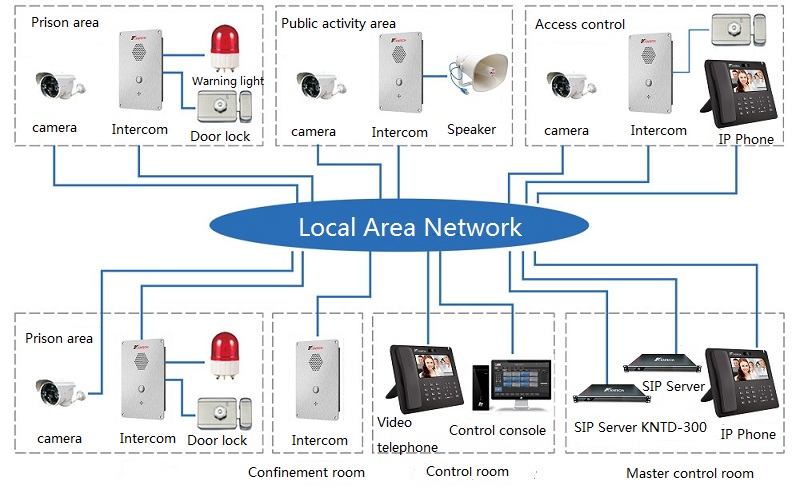
Not every layer of prison communication control faces outward toward families and attorneys. A significant portion runs inward, linking control rooms to the places where daily life actually happens: cell blocks, corridors, gates, and visitor booths. This internal fabric is what lets staff hear a call for help, issue a announcement across a housing unit, or screen a visitor before the door opens. Jacques addresses this side of the problem with true IP intercom and PA systems that tie into CCTV and access control, so a single platform can carry voice, video, and door functions together. Its Self-Test Button is a practical example of that philosophy: rather than waiting for a unit to fail, staff can remotely check push buttons, acoustics, and data communications, with the system logging diagnostics and raising an alarm the moment something stops working. The platform goes further, supporting tamper-proof smart recording of multiple audio streams, an IP network audio recorder, five-second heartbeat signals, and reporting on more than 320 critical events.
Configurable event triggers are where these systems earn their keep: CCTV switching, light control, door release, message announcement, night call diversion and alarm scheduling. Interfaces include Modbus/TCP, Inner Range Concept 4000 and OPC, with auto-forward to an external phone over a SIP trunk. Acoustic Echo Cancellation strips background noise from cell conversations, and an audio volume trigger can flag a raised voice.
CTI takes a comparable approach, giving officers control over voice, video and data channels from one interface, with centralized paging and intercom, video intercoms for visitor screening, duress buttons, zoned audio, secure inmate platforms with logging and tamper-proof devices on secure cabling. Zenitel focuses on automatic call set-up, talk-through-glass, intercoms in visitor areas and booths, and broadcast of live or prerecorded messages to cells, sections and common areas for information, warnings and evacuation. Commend provides voice and video between cells, corridors, doors, gates, security locks and barriers with self-monitoring.
Contraband phones get their own layer. Jamming systems suppress cellular reception only when required and within defined areas. Detector and jammer counts are configured per prison so that calls remain possible in the surrounding neighborhood and in parts of the building that are not meant to be covered.
Rate Caps, Monopoly Power and the Cost of Staying in Touch
The economics of prison communication control are the part families feel every week. The FCC adopted rate caps in its 2024 IPCS Order, listing $0.09 for prisons regardless of average daily population, with separate caps for large jails of 1,000 or more. The Commission has stated plainly that providers hold monopoly power in the facilities they serve, which produces egregiously high rates.
Reporting from Truthout in May 2025 described prison phone and messaging services run by private firms such as Aventiv and Global Tel Link charging up to 50 cents per message, often paying commissions back to the prisons that award the contracts. Those commissions are the quiet mechanism that makes high rates politically durable: the facility gets revenue, and the vendor gets an exclusive territory.
Mail has followed a similar path. Since 2017, at least 16 states and the Federal Bureau of Prisons scan all incoming mail and deliver electronic scans instead of originals. The stated goal is contraband reduction, and it works on that narrow measure. The trade-off is that physical letters disappear, replaced by a large surveillance database whose retention rules are rarely spelled out.
How Do Integrated IP Platforms Compare With Legacy Systems?
Legacy analog and PSTN systems are fragmented, outdated and create information bottlenecks. Officers juggle separate consoles, recordings live on disconnected hardware, and pulling a call for an investigation can take longer than the investigation itself. Integrated IP platforms improve situational awareness and cut response time because voice, video, access control and alarms share one interface and one log.
The trade-offs do not disappear with better hardware. Monitoring supports investigations and accountability but undermines attorney-client confidentiality, which is exactly the tension the NACDL data captures. Video calls and electronic messaging expand contact but carry fees and can replace in-person visitation rather than supplement it. Mail scanning reduces contraband risk but removes physical traces of letters and creates a surveillance database with unclear data retention.
Scale is the backdrop for all of it. UNODC reported in July 2025 that 11.7 million people were incarcerated in 2023, and that more than 60% of the 181 countries with data run prison systems above 100% capacity. The Sentencing Project found the U.S. prison population rose 2% in 2023, led by increases in 39 states. RTI estimates nearly 1.5 million adults in state or federal prisons and nearly 750,000 in jails. More people, more channels, more monitoring and more billing follow from those numbers.
What Should Families and Advocates Watch For?
Anyone navigating this system should start with the contract, not the app. Ask which provider holds the exclusive agreement, what the per-minute and per-message rates are under current caps, and whether commissions flow back to the facility. Those three answers explain most of the cost a family will pay.
Second, understand the monitoring default. Under the NACDL findings, the safe assumption is that calls are recorded and may be reviewed, and that confidentiality with an attorney is not guaranteed by the technology itself. Third, treat mail scanning as a data question: find out what is stored, for how long and who can query it. The technology will keep improving, but the rules around it are still being written, and they are being written in public dockets and state contracts that anyone can read.
Key Terms in Prison Communication Control
The vocabulary in this field is dense and often used interchangeably by vendors and regulators. The table below maps the terms you will encounter to what they actually mean in practice.
Frequently Asked Questions
What forms of communication are available to incarcerated people?
NACDL survey data shows private in-person meetings (89%), telephone calls (83.5%) and mail (82%) are the most common forms of contact. Public in-person meetings, email and private video are available only about a quarter to a third of the time, at 34%, 33% and 24% respectively. Digital channels remain supplements rather than replacements for older ones.
Are prison phone calls confidential?
Rarely. In the NACDL survey, 87% of lawyers said clients could not take calls with no one else listening. Sixty-nine percent reported calls were monitored by the state, 15% in real time and 54% recorded, while 48% knew of cases where recordings reached prosecutors. Only 9% said recordings arrived via court order or search warrant.
How do prison communication systems monitor and control calls?
Platforms such as ASTPP use VoIP with whitelist and blacklist control, authentication and policy enforcement, live call monitoring, automatic recording storage, call detail records and audit analytics. Jacques systems add self-test buttons, tamper-proof recording and five-second heartbeat health monitoring. Inmate kiosks validate permissions before a call connects and log the billing data afterward.
What are the FCC rate caps for incarcerated people's communications services?
The FCC adopted IPCS rate caps in its 2024 IPCS Order, listing $0.09 for prisons regardless of average daily population, with separate caps for large jails of 1,000 or more. The FCC notes that providers often hold monopoly power in the facilities they serve, which produces egregiously high rates for families.