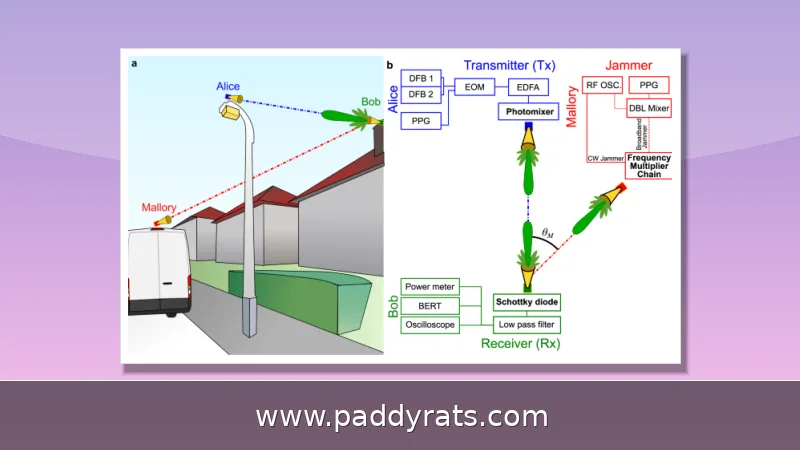
mmWave jamming targets narrow, high-frequency links with deliberate interference, yet the same directionality that makes these beams fragile also makes them hard to find and jam. Here is how the attacks work, how detection and joint analog-digital beamforming fight back, and where the trade-offs land.
What Is Millimeter Wave Jamming and Why Does It Matter?
Millimeter wave jamming: in some cases called rf jamming, it is the intentional radio-frequency interference (signals that block vehicle and tactical network links) to mmWave systems operating ordinarily in a frequency range of approximately 24–100 GHz; with some investigators defining this spectrum as broadly from around 30-300GHz. Since mmWave features multi-gigabit throughput and sub-millisecond latency, a positive jam does not merely drop video calls; it can sever a sensor mesh, blind a radar or cut off half command link from forward operating base.
This threat is becoming a bigger deal as both defense and commercial networks keep moving up the frequency spectrum. Old VHF and UHF systems sitting below 3 GHz broadcast in every direction, which makes them a cinch to pick up on. mmWave, on the other hand, packs its energy into tight, narrow beams. That difference flips the attacker's challenge on its head. Rather than flooding a wide area with noise, a jammer now has to locate and lock onto a beam that's about as wide as a pencil. If you've ever typed "how does millimeter wave jamming work" into a search bar, this is probably the tension you were trying to understand — and honestly, it's the thread that connects every technique we're about to cover.
How Does RF Jamming Work Across Barrage, Spot, and Sweep Techniques?
RF jamming, at a high level, sends out a signal on the target frequency that is more powerful than legitimate transmission so the receiver latches onto you and your equipment instead of its intended source. The physics of the interaction are hard to argue against as well:if an interfering signal comes in strong enough at that antenna, there is no way for a demodulator circuit to understand which waveform contains the true information or not.
Attackers mixing multiple techniques based on how much information they have about that target. Noise jamming overwhelms the channel with consistent noise and deceptive jamming transmits false signals meant to be considered legitimate traffic. In barrage jamming, energy is distributed over a wide range of frequencies while in spot jamming it focuses on one frequency. In sweep jamming, an interferer weaves across a band. To these, radar tacks on its own lexicon: mechanical jamming redeploys enemy radio signals to produce fake or misleading target returns and electronic jamming encompasses the rest.
| Jamming Type | Method | Best Against | Trade-off |
|---|---|---|---|
| Noise | Continuous high-power noise on target frequency | Any receiver in band | High power, easy to geolocate |
| Deceptive | Fake signals mimicking legitimate traffic | Protocol-aware links | Requires target knowledge |
| Barrage | Energy spread across wide frequency range | Frequency-hopping systems | Diluted power per channel |
| Spot | Concentrated on one frequency | Fixed-frequency links | Useless if target moves |
| Sweep | Narrow interferer scanning a band | Slow-hopping radios | Intermittent coverage |
The table brings life to the job of a defender: a wide-band jammer that sacrifices power density, while one focussing on a single frequency becomes predictable. The narrow beams of mmWave push attackers to the objectionable hard task of tracking a track-lead target (moving, directional) instead just an omnidirectional disturbance.
Why Are mmWave Signals Both Vulnerable and Hard to Jam?
mmWave's highly directional nature and sensitivity make signals particularly susceptible to jamming attacks. Propagation is line-of-sight, and virtually any obstruction reduces performance, so a well-placed interferer or even a building can break a link. Attenuation is also not linear across the band: roughly 0.1 dB/km at 18 GHz, at least 12 dB/km at 60 GHz, about 0.8 dB/km at 80 GHz, and about 0.8 dB/km at 95 GHz, according to dB Control's September 3, 2024 analysis of the millimeter-wave spectrum.
But that same tight focus cuts both ways. Because mmWave beams are so narrow and directional, they're actually harder to detect, locate, or intercept than the omnidirectional legacy RF we're used to, which is exactly why the high-attenuation frequencies look so appealing for secure communications. The physics backs this up: for the same RF output power and identical antennas at both ends of the path, a 140 GHz signal in free space comes in 5.7 dB stronger than one at 73 GHz, and a full 14 dB stronger than one at 28 GHz, according to the same dB Control analysis. So in practice, mmWave is fragile but quiet at the same time, and that combination ends up reshaping how both attackers and defenders approach the problem.
What Is the Opportunistic Wiretapping and Jamming (OWJ) Attack Model?
The OWJ attack model in this paper is a new attack mode of mmWave wireless networks: that an adversarial eavesdropper does the wiretapping or jamming temporally opportunistically by first determining if it is cheap to do so at present. The adversary can listen, do interference or both and chooses which option to pursue by analyzing the current channel geometry as well as payoff instead of committing blindly. A 2022 TechRxiv paper by Y. Zhang described the model, and a 2024 IEEE publication by S.Jayasree expanded it along with its applications to opportunistic wiretapping using millimeter-wave wireless networks under jamming conditions.
The combination will be the dangerous part. Jamming-only denies service; snooping-only leaks data. Using jamming and wiretap in concert can pose a more serious attack than either technique alone; the interference may hide the exfiltration or compel resort to a better-protected path. Thus, confidentiality and availability cannot be treated as independent problems for mmWave networks by the defenders.
| Attack Mode | Primary Goal | Defender Impact |
|---|---|---|
| Wiretapping only | Intercept traffic | Confidentiality loss |
| Jamming only | Deny service | Availability loss |
| OWJ combined | Intercept while masking | Both, harder to attribute |
That three-row framing is why physical layer security, low probability of detection (LPD), and anti-jamming design increasingly get discussed together rather than as separate research silos.
How Does Direction-Based Jamming Detection Work in mmWave Massive MIMO?
Direction-based detection uses the directional information of received signals at the base station antenna array. During training, the system inspects pilot signals to determine both whether a jammer exists and where it sits in angular space. That angular estimate is the key that unlocks the rest of the defense: once the jammer's direction is known, its contribution can be separated from legitimate users.
The receiver then excludes the jammer's angular subspace from channel estimation and cancels deliberate interference at the combiner. Work published in arXiv 2104.01856v1 on April 5, 2021 reported spectral efficiency close to the no-jamming case even when jammer power is substantially lower than user power. More recently, Z. Fan's 2026 SPIE conference proceedings paper described an unsupervised jamming detection method for mmWave radar, showing the same directional logic is spreading from communications into sensing.
| Detection Step | What Happens | Output |
|---|---|---|
| Pilot training | Array observes received signals | Angular signatures |
| Jammer identification | Existence and direction estimated | Jammer angle |
| Subspace exclusion | Jammer angle removed from estimation | Cleaner channel estimate |
| Combiner cancellation | Interference nulled at receiver | Recovered user signal |
The sequence shows why massive MIMO is such a natural fit for mmWave anti-jamming: spatial separation does work that frequency filtering cannot, especially when the interferer shares the same band as the user.
How Does Joint Analog-Digital Beamforming Enable Anti-Jamming 5G mmWave?
A joint analog-digital beamforming receiver combines online-learning Bayesian optimization for analog beamforming with modified MMSE digital detection. The analog stage steers the beam direction to maximize signal quality while suppressing interference, and the digital stage, a modified minimum mean square error detector, mitigates residual interference by balancing noise suppression against signal recovery. Huacheng Zeng's INSS Lab at Michigan State University demonstrated this architecture in an anti-jamming 5G project using National Instruments USRP devices.
The result, published by P. Yan, B. Zhang, S. Zhang, Kai Zeng, and H. Zeng in IEEE Transactions on Machine Learning in Communications and Networking in 2025, enables robust packet decoding even without prior knowledge of the jammer's waveform. That matters operationally: an adversary can change modulation or timing, but the Bayesian loop keeps adapting the analog beam while the digital detector cleans up what remains. Validation ran on a 28 GHz over-the-air testbed, the same 28 GHz mmWave setup used for anti-jamming evaluation in the MSU INSS Lab work.
| Layer | Technique | Role |
|---|---|---|
| Analog | Bayesian optimization beam steering | Maximize signal, suppress interference |
| Digital | Modified MMSE detection | Cancel residual jamming |
| Testbed | 28 GHz over-the-air | Validate without jammer waveform knowledge |
Readers who want the foundational survey should look to H. Pirayesh and H. Zeng's comprehensive review of jamming attacks and anti-jamming strategies in wireless networks, published in IEEE Communications Surveys and Tutorials, volume 24, number 2, pages 767-809, in March 2022.
How Do mmWave Tactical Networks Compare With Legacy VHF and UHF Systems?
Legacy VHF and UHF links below 3 GHz offer limited throughput, omnidirectional coverage, a high RF signature, moderate jamming resistance, and heavy GPS dependence. mmWave tactical links in the 24-100 GHz range deliver multi-gigabit rates, directional beamforming, low probability of detection, high jamming resistance, and mesh compatibility that does not depend on GPS, as described in Blu Wireless's PhantomBlu platform materials for stealth-ready tactical connectivity.
The trade-off is physical. mmWave propagation is line-of-sight, obstructions significantly reduce performance, and propagation changes with altitude, precipitation, and height above sea level, per dB Control. mmWave behaves like light: high directivity, small diffraction, and large atmospheric signal power attenuation. That makes long-distance base-station-to-user transmission hard, but short-distance links, in-vehicle radar, and high-precision sensing very attractive. Hirose Electric's mmWave coaxial connectors exist precisely because circuit boards, antennas, connectors, and cables all need high-precision peripheral components to keep losses manageable.
| Attribute | Legacy VHF/UHF | mmWave Tactical |
|---|---|---|
| Frequency | Below 3 GHz | 24-100 GHz |
| Throughput | Limited | Multi-Gbps |
| Beam | Omnidirectional | Directional beamforming |
| RF signature | High | Low probability of detection |
| Jamming resistance | Moderate | High |
| GPS dependence | High | Mesh-compatible, GPS-independent |
Mesh networking is the operational answer to the fragility problem: decentralized, self-healing, and redundant, with nodes relaying and rerouting traffic without a central hub. Where legacy centralized structures create a single point of failure in contested or denied environments, a mesh of directional mmWave nodes can absorb a jammed link and route around it.
What Countermeasures and Practical Steps Reduce mmWave Jamming Risk?
Anti-jamming receiver design starts with combining analog beamforming driven by Bayesian optimization and digital modified MMSE detection, then validating the whole chain on a 28 GHz over-the-air testbed rather than in simulation alone. That pairing matters because analog beamforming handles the geometry of the interferer while digital detection handles what leaks through, and neither stage alone matches the measured performance of the joint approach.
Beyond the receiver, mmWave absorbers disperse jamming signals as a form of electromagnetic protection, and high-attenuation frequencies are deliberately chosen for secure communications to reduce interception and jamming likelihood. Direction-based detection, subspace exclusion, and combiner cancellation round out the toolkit. The practical takeaway for network planners is to treat low probability of detection, physical layer security, and mesh redundancy as one design problem, because OWJ-style adversaries exploit exactly the seams between them.
Frequently Asked Questions
Why are millimeter wave signals vulnerable to jamming?
mmWave's highly directional nature and sensitivity make signals particularly susceptible to jamming attacks. Propagation is line-of-sight, and virtually any obstruction reduces performance. However, tightly focused beams also make mmWave transmissions harder to detect, locate, or intercept than omnidirectional legacy RF.
How does anti-jamming 5G mmWave communication work?
A joint analog-digital beamforming receiver combines online-learning Bayesian optimization for analog beamforming with modified MMSE digital detection. This suppresses jamming in both domains, enabling robust packet decoding even without prior knowledge of the jammer's waveform, validated on a 28 GHz over-the-air testbed.
What is the opportunistic wiretapping and jamming attack model?
OWJ is a new attack model in mmWave wireless networks where an eavesdropper opportunistically conducts wiretapping or jamming based on instantaneous costs. Combining jamming with wiretapping creates a more hazardous attack than either technique alone.
How is jamming detected in mmWave massive MIMO systems?
Direction-based detection uses the directional information of received signals at the base station antenna array. It accurately detects both the existence and direction of a jammer using pilot signals during training, then excludes the jammer's angular subspace from channel estimation and cancels interference at the combiner.