.jpg)
Waterproof outdoor drone jammers combine IP65/IP66 enclosures, multi-band RF output, and 1,000-2,500 m ranges for fixed counter-UAS duty. Here is what the hardware actually delivers, how installation works, and why US law still limits who can switch it on.
What Is a Waterproof Outdoor Drone Jammer?
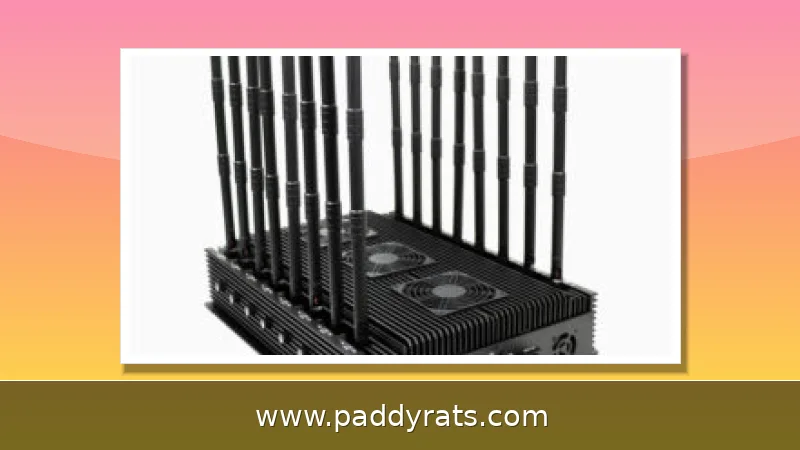
A waterproof outdoor drone jammer is basically a fixed or semi-fixed RF transmitter that lives on a rooftop, pole, or vehicle and cuts the radio link between a drone and whoever's flying it — rain, dust, temperature swings, all of it. You'll see these sold under a bunch of names: outdoor UAV jamming system, IP66 anti-drone jammer, counter-UAS (C-UAS) unit. The enclosure rating is kind of the whole point here. An indoor box that quits in a storm won't do you any good for 24/7 perimeter duty.
The market basically breaks down into three physical formats. Fixed outdoor units give up portability in exchange for continuous operation—no runtime limit, and higher power output. Portable suitcase and handheld jammers run on battery, typically somewhere between 30 minutes and 2 hours. Vehicle-mounted systems fall somewhere in the middle, drawing power and mobility from the vehicle itself. And across the board, the published jamming radius usually lands between 200 and 3,000 meters, though that depends on power class, antenna type, and terrain.
How Outdoor Drone Jamming Works: RF, GNSS and Spoofing
Drone jammers work by flooding the radio frequencies drones rely on — command, control, video, and navigation — with electromagnetic noise. Once that noise overwhelms the link, most commercial drones fall into a fail-safe mode: they either return to home, hover in place, or land. The bands you'll see targeted most often are 433 MHz and 900 MHz for control, 1.2 GHz and 1.5 GHz for video and telemetry, 2.4 GHz and 5.8 GHz for command-and-control on DJI and most consumer drones, and the GNSS bands — GPS, GLONASS, Galileo, BeiDou — which sit between 1164 MHz and 1610 MHz.
Spoofers take a completely different approach. Rather than flooding the airwaves with noise, they transmit counterfeit signals designed to hijack a drone's control link or feed it a false position. Out in the field, two basic physics principles shape how any of this performs. First, jamming strength drops off with distance—the farther the signal has to travel, the weaker it gets. Second, effectiveness actually goes up as the pilot's remote moves farther from the drone, since the jammer's signal becomes relatively stronger at the drone's receiver compared to the legitimate control signal. Antenna choice matters too. Directional antennas concentrate energy in one direction and reduce collateral interference, while omni antennas cover a full 360 degrees but with lower gain in any single direction.
Key Specifications: Bands, Output Power and Jamming Range
Spec sheets are usually where people's eyes glaze over, so when I'm comparing outdoor drone jammers I try to narrow things down to four numbers: how many bands the unit covers, total RF output, the range the vendor claims, and its IP rating. Those four tell you most of what you need before you dig into the fine print. The table below rounds up a few representative outdoor and portable models pulled straight from vendor documentation, including the Jammers4u CT-3090DJ-UAV series, the VBE-9ODM250D, the TTSKC03 suitcase unit, and the Airsight Smart and Autonomous Jammer.
| Model | Bands / Output | Range | Rating & Weight |
|---|---|---|---|
| Jammers4u CT-3090DJ-UAV | 5-7 bands, 100-175 W | 1,000-2,500 m, 360-degree omni | IP66, 20-25 kg |
| CT-3091DJ-UAV / 3092 / 3093 | 5 band 100 W / 6 band 150 W / 7 band 175 W | Same series envelope | IP66 |
| VBE-9ODM250D stationary | 200 W RF, 600 W consumption | Up to 1,000 m | IP65, 30 kg |
| TTSKC03 suitcase | 80 W total, four bands at 20 W | 1,000-1,500 m | IP65, 13.8 kg |
| Airsight Smart and Autonomous | Manual and automatic modes | 1.9 miles, 360-degree | Fixed / tripod / vehicle |
The CT-3090DJ-UAV series breaks its power down band by band: 10 W at 5.7–5.9 GHz, 20 W at 2.4–2.5 GHz, 40 W at 1570–1620 MHz covering GPS L1 and GLONASS L1, 50 W at 433 MHz, and 25 W at 860–920 MHz. If you need GPS L2, L3, L4, or L5 as well, that's an optional add-on at 20 W. For power, the unit accepts AC 110 V or 220–240 V, plus DC 27 V. It weighs 20–25 kg and measures 470x380x290 mm, and it's rated to keep running from -20 to +60 C.
A few other units are worth keeping on your radar. The Hinaray HN-19003 covers GPS at 1560–1620 MHz, plus video links at 2400–2500 MHz and 5725–5850 MHz. If you need something handheld, the Hinaray HN-171018 runs 30 W on each of the 1.5G, 2.4G, and 5.8G bands, giving you a 1,500 m range in a 9.5 kg package. Then there's the Phantom EAGLE 108, which claims detection and jamming out to 4 km across seven band groups, and the Skyfend AFA100, which pairs 3,000 m of jamming with 2,000 m of detection covering 400 MHz to 6 GHz. The DedroneDefender 2 leans on AI targeting to reach drones beyond 300 m, even when they're out of sight. For longer-range work, the Skylock Modular C-UAS stretches to 5 km and can be mounted on a vehicle. On the lighter end, the D-US-04 Shield is a 25 W, 2.1 kg, IP55 unit rated to 1,500 m. And the EDM4S SkyWiper—used by the Ukrainian Armed Forces—runs about $15,000 per unit.
IP65 vs IP66: Waterproofing and Outdoor Installation
IP65 and IP66 are both dust-tight, so the real difference comes down to water: IP65 handles jets of water, while IP66 stands up to stronger jets and heavy rain. The CT-3090DJ-UAV series carries an IP66 rating and is sold as fully waterproof and rainproof, whereas the TTSKC03 and VBE-9ODM250D are rated IP65. Still, the enclosure rating only tells part of the story. Power and RF cable connectors tend to be where water gets in first, so seal every connector even if the main unit itself is waterproof.
Mounting options come down to pretty much the same reasoning. A rooftop or some other elevated spot is the best choice, with pole mounting as the fallback. From there, lightning protection should be a priority, and that means lightning rods — a mast-mounted jammer is basically a tall metal pole begging to get struck. Bolt down every pre-drilled mounting hole, then check the tightness on a regular schedule. Vibration and temperature swings will work hardware loose over months of outdoor service, so this isn't a one-and-done step.
Fixed, Portable and Vehicle-Mounted Options Compared
Choosing a format is really choosing a mission. Fixed outdoor units run continuously with no time limit and higher power, which suits permanent site protection. Portable units trade power and runtime for mobility, typically running 30-120 minutes on battery; the TTSKC03 uses a 24 V 5 A lithium battery good for 1.5-2.0 hours with a 4-hour charge. Vehicle-mounted systems such as the Skylock Modular C-UAS and Airsight's tripod/vehicle options combine mobility with external power.
Antenna choice drives coverage more than raw wattage. Omni antennas give 360-degree coverage but spread energy, while directional antennas concentrate it on a bearing and reduce collateral interference with nearby phones, GPS receivers, and emergency 9-1-1 calls. If your site has a known approach corridor, a directional head usually outperforms a higher-power omni unit aimed at nothing in particular.
Are Drone Jammers Legal in the United States?
No, not for private users. Under the Communications Act of 1934, the FCC prohibits operating, marketing, or selling jamming devices, and fines run up to $112,500 per incident; 47 U.S.C. 301, 302a, and 333 make operation, marketing, or sale a federal crime unless authorized. That applies to drone jammers the same way it applies to cell jammers. Buying an IP66 outdoor unit and plugging it in at a private facility is not a gray area.
The authorized carve-outs have widened. The SAFER SKIES Act in the FY2026 NDAA newly authorizes state and local law enforcement after training at the FBI National Counter-UAS Training Center in Huntsville, Alabama, plus correctional agencies and NSSE/SEAR event protection such as the FIFA World Cup 2026. In January 2026, JIATF-401 updated guidance expanding Title 10 authority for the DoD and military installations. If you are not one of those entities, the legal path is detection and coordination with law enforcement, not jamming.
Risks and Limitations Buyers Underestimate
Jammers are illegal in most countries including the US, and legality is only the first limitation. They are less effective against pre-programmed drones flying without GPS, since there is no live control link to sever. They do not give positive control, do not locate the pilot or the flight path, and can disrupt nearby cellphones, GPS, and emergency 9-1-1 calls. Non-kinetic measures can also end with drones falling at speed, which is undesirable over crowds or critical infrastructure.
That is why serious buyers pair jamming with detection. Airsight integrates its jammer with AirGuard detection, and the Skyfend AFA100 combines 3,000 m jamming with 2,000 m detection in one unit. The market itself is expanding fast: MarketsandMarkets estimates UAV jammers at USD 1.77 billion in 2026, projected to reach USD 5.90 billion by 2031 at a 27.2 percent CAGR. Budget for detection, legal review, and training alongside the hardware, not after it.
What Should You Check Before Buying an Outdoor Drone Jammer?
Start with the threat, not the wattage. Identify which drone classes and control bands actually operate near your site, then match band coverage: 433 MHz and 900 MHz control, 1.2 GHz and 1.5 GHz video and telemetry, 2.4 GHz and 5.8 GHz command-and-control, and GNSS between 1164 MHz and 1610 MHz. A seven-band 175 W unit is wasted if your real threat uses one band you already cover.
Then verify the boring details: IP65 or IP66 enclosure, operating temperature range such as -20 to +60 C, AC 110 V or 220-240 V and DC 27 V power options, warranty length, and spare-part availability. The CT-3090DJ-UAV series, for example, ships with a two-year warranty and a listed price of $5,800, down from $6,300. Finally, confirm who is legally allowed to operate the unit at your location before the crate arrives, because that answer determines whether the purchase makes sense at all.
Terminology and Synonyms You Will See in Spec Sheets
Vendors use overlapping terms, which makes comparison harder than it should be. You will see drone jammer, anti-drone jammer, UAV jammer, drone jammer gun, counter-UAS (C-UAS), RF jammer, GNSS jammer, spoofer, non-kinetic soft-kill, drone blocker, and UAV radio blocker, often describing the same class of hardware. A drone jammer gun is usually a handheld directional unit; a drone blocker or UAV radio blocker is typically a fixed or portable RF transmitter.
Spoofer is the one term that is not interchangeable. A jammer denies the link with noise, while a spoofer emits counterfeit signals to hijack control or falsify position. Some systems combine both. When you read a spec sheet, check whether the listed bands are jamming bands, spoofing bands, or detection bands, because mixing them is the most common way buyers end up with coverage they did not actually purchase.
FAQ
See the questions and answers below for quick reference.
Frequently Asked Questions
What does a waterproof outdoor drone jammer do?
It broadcasts electromagnetic noise on drone control, video, and GNSS frequencies, drowning out the link between the drone and its operator. The drone then returns home, hovers, or lands. Outdoor fixed units use omni or directional antennas and IP65 or IP66 enclosures for permanent rooftop or pole installation.
How far can an outdoor anti-drone jammer reach?
Published ranges vary widely. Fixed units list 1,000 to 2,500 meters, the VBE-9ODM250D over 1,000 meters, and the Airsight Smart and Autonomous Jammer 1.9 miles of 360-degree coverage. Actual distance depends on signal strength, antenna type, terrain, and installation height, so treat vendor numbers as best-case figures.
Are drone jammers legal in the United States?
No for private users. Under the Communications Act of 1934, the FCC prohibits operating, marketing, or selling jamming devices, with fines up to $112,500 per incident. Only authorized government entities, and under the SAFER SKIES Act certain trained state and local agencies, may operate them legally.
What IP rating should an outdoor drone jammer have?
Listed outdoor models use IP65 or IP66 enclosures. The CT-3090DJ-UAV series is IP66 and described as fully waterproof and rainproof, while the TTSKC03 and VBE-9ODM250D are IP65. Cable and connector sealing matters as much as the case rating, since connectors are the usual water-entry point.