IMSI catchers, also called cell-site simulators or Stingrays, impersonate real cell towers to harvest phone identifiers and track location. Here is how they work, what they can and cannot do, and how to detect and defend against them.
What Is an IMSI Catcher and What Else Is It Called?
An IMSI catcher (also known as a cell-site simulator or CSS) is an eavesdropping device for mobile phones used to intercept telephone calls and track location. It pretends to be a real cell tower, so the phones in range connect naturally and then it grabs identifiers like IMSI on its SIM. IMSI derives its name from International Mobile Subscriber Identity, which is a permanent number that identifies maybe could be identified uniquely to the mobile device connected and authenticated on network operator. So far, a dramatic alarm has not been the giveaway of network-monitoring tools that I have tested myself; it was always rather a quiet anomaly: A tower showing up once and never again.
It is referred to by many names, and when searching for research or vendor documentation knowing the synonyms can be very helpful. What are common labels ascribed to radio equipment and how do they differ? The underlying method is a machine-in-the-middle (MitM) attack on the radio link. Many organizations have documented this space, including the Electronic Frontier Foundation (EFF), Open Technology Fund (OTF), South Lighthouse, SeaGlass from future of privacy forum and University of Washington, Canadian Centre for Cyber Security(ITSAP. 00. 106), and NIST, Zimperium, Cape & SnoopSnitch & Eagle Security (page 1 • page 2) / GrapheneOS + SovereignOS – Stratign- Mirage5G.
How IMSI Catchers Exploit Cell Network Trust
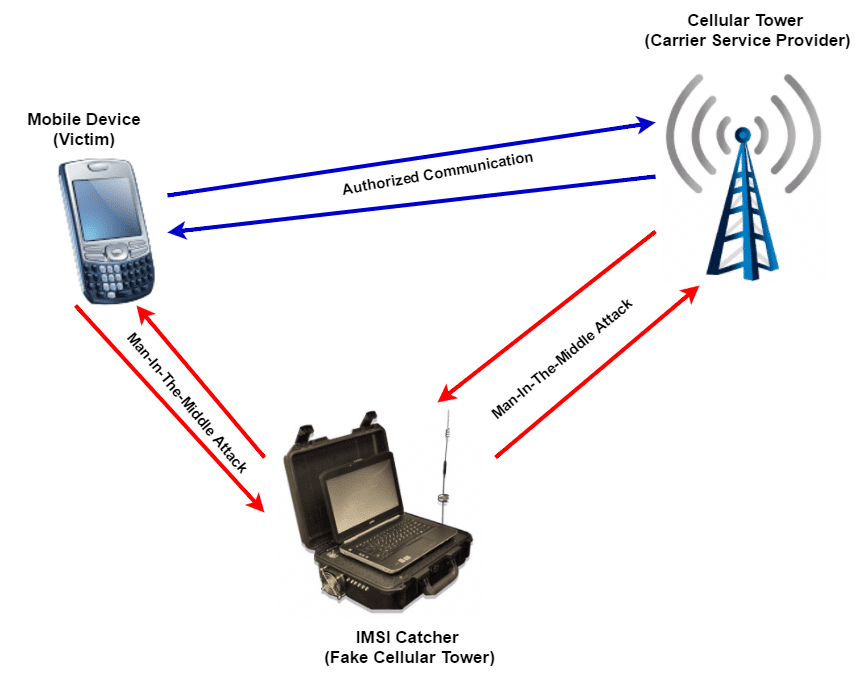
Cellular networks operate on a simple premise; Phones will attach to the base station, broadcasting with the highest signal strength. That's exactly what an IMSI catcher does– by raising a tower with actually more powerful, or seemingly more effective signal than those around it. The phone has no cause to question it and relinquishes control. This is the reason why this attack is considered a trust problem more than a cryptography one.
The interception occurs during the connection handshake. When the base station asks for encryption from the phone an IMSI catcher can simply ignore this answer (use no response) or say it is not necessary. The base station will then transmit an Identity Request and the phone responds with the IMSI held on the SIM. The catcher logs it and sends the phone back out to real network, usually within seconds. The user typically notices nothing.
Older 2G networks have well-documented security vulnerabilities: encryption is optional and algorithms such as A5/1 can be cracked on the fly. In well focused radio environments, modern LTE phones do not scan for other towers if signal strength is above a sufficient threshold meaning attackers have no simple method to pull them in. Then we see why real attacks prefer to downgrade 2G than directly break new encryption.
Active vs Passive IMSI Catchers and the Silent SMS Attack
IMSI catchers fall into basically two operational styles, and that distinction dictates what defenders can observe. Active catchers amplify network signals, broadcasting them stronger than legitimate towers — a short range signal intended to induce devices into dropping their connection and backing toward the catcher (downgrade connections even to 2G). Passive catchers omit any broadcast entirely; rather they track and bottle up cellular transmissions in flight as they flow by on characterless decoders. Passive systems are considerably more difficult to spot because they do not generate an obvious radio signature.
A similar technique is silent SMS: a text message that the device processes without telling the user or storing it anywhere. Silent SMS are utilized by Operators and attackers to locate a phone, (re)configure SIM profiles or send configuration instructions. As the user never sees it, a silent SMS is an useful reminder that notifications alone cannot be relied upon for detection.
The table below breaks down the main differences between these two classes in terms of how visible they are and how they behave.
| Attribute | Active IMSI Catcher | Passive IMSI Catcher |
|---|---|---|
| Broadcasts network signal | Yes, often stronger than real towers | No |
| Typical effect on phone | Disconnect and reconnect, possible 2G downgrade | No visible change |
| Detection difficulty | Moderate, anomalies are observable | High, minimal radio footprint |
| Primary goal | Interception and forced connection | Silent identifier collection |
| Common add-ons | Jamming and denial-of-service features | Transmission tracing and logging |
That difference matters for anyone developing a defense plan. The active catchers create abrupt effects, e.g. a sudden loss of service for the victim or an undesired technology downgrade; by contrast, passive attackers leave mainly metadata traces that can only be identified through long-term analysis of network data {esp|iap}. In practice, most consumer-oriented detection advice focuses on live systems since those are the only ones where a phone or app could plausibly detect something happening.
What IMSI Catchers Can and Cannot Do
Price and generation variations really diverge in capabilities. IMSI catchers work on numerous cellular bands (GSM, UMTS and LTE) or even the new 5G networks as well with a few systems are totally passive. They often carry jamming technology that can push 3G and 4G phones to unusable speeds, in addition to other denial-of-service functionality. Advanced features could consist of intercepting texts, eavesdropping calls, tracking data such as numbers dialed and web pages visited in addition to extracting images along with messages from the targeted device.
On the commercial side, some systems claim interception of 2G, 3G, 4G, and 5G networks, calls and messages, and support for 4 to 32 OSINT targets. Smart IMSI surveillance systems add intrusion detection, motion and acceleration detection, object classification, and behavior analysis. Costs reflect that range: commercial IMSI catchers run from about $1,500 for basic DIY setups to over $400,000 for sophisticated government-grade systems. Portable devices range in size from a walkie-talkie to a suitcase, and in price from several thousand to hundreds of thousands of dollars.
What they cannot do is equally important. On modern 4G and 5G networks, mutual authentication makes silent interception much harder, so many practical attacks work by downgrading the phone to 2G first rather than breaking current encryption. An IMSI catcher also cannot magically decrypt end-to-end encrypted messaging content; at best it captures metadata. That is the core reason security professionals push both network hardening and encrypted apps rather than choosing one.
Mobile Identifiers: IMSI, IMEI, TMSI, GUTI, SUPI and SUCI
Understanding identifiers is the fastest way to understand what a catcher actually steals. The IMSI is a permanent, unique 15-digit number stored on the SIM; it reveals the mobile country code, the network operator, and the subscriber identifier. The IMEI is a separate unique identifier for the physical phone device, independent of the SIM. Together they let an operator or an attacker link a specific handset to a specific subscriber.
Networks try to protect the IMSI by assigning temporary identifiers. TMSI and GUTI are temporary values designed to hide the permanent IMSI during normal operation. If they are not rotated frequently, or if the numbering is predictable, they can be linked back to a user over time. This is exactly the kind of pattern that long-running sensor projects are built to catch.
5G introduces SUPI and SUCI. SUCI is the encrypted version of SUPI, but null encryption, meaning no encryption at all, is a permitted standard option for 5G networks, which diminishes SUCI protection in practice. IMSI catchers can also attempt to downgrade a device to 2G or 4G where SUCI does not exist, sidestepping the newer privacy design entirely.
| Identifier | What it identifies | Persistence |
|---|---|---|
| IMSI | Subscriber identity on the SIM | Permanent, 15 digits |
| IMEI | Physical handset | Permanent, device-bound |
| TMSI / GUTI | Temporary subscriber identity | Temporary, rotated by network |
| SUPI | 5G subscriber identity | Permanent |
| SUCI | Encrypted SUPI | Protected unless null encryption is used |
Detection Methods, Apps and Their Limits
Detection methods monitor network irregularities, downgrades to earlier network technologies, unusual base station parameters or fingerprints, and ephemerality, meaning a network that appeared only briefly. None of these signals is conclusive on its own, which is why serious detection combines several indicators over time. Field research shows the scale of the problem: the FADe project, run by South Lighthouse with support from the Open Technology Fund, worked with partners in nine countries from 2019 to 2022, documenting signals from almost 9,000 antennas and catching more than 150 likely IMSI catchers.
Some projects have focused on dense urban environments. SeaGlass, from the University of Washington, deployed sensors in 15 ridesharing vehicles in Seattle and Milwaukee over two months and identified dozens of anomalies consistent with cell-site simulators. Data from Caracas, Venezuela showed 33 different devices with irregular readings that could indicate IMSI catchers. These efforts matter because they turn anecdotal suspicion into measurable patterns across a city.
On the consumer side, SnoopSnitch is open source, collects and analyzes mobile radio data, warns about IMSI catchers, SS7 attacks, and user tracking, and checks firmware for Android security patches. Network security and attack monitoring require a rooted device with a Qualcomm chipset running stock Android 4.1 or higher. Eagle Security tracks stations, signatures, and positions, warns of suspicious activity, offers spyware protection, and requires Device Administrator permission.
iPhone IMSI catcher detector apps are unavailable because iOS does not allow third-party apps to access low-level network data. For iPhone users, the practical defenses are behavioral rather than app-based. Public concern is high: a 2023 survey found about 57% of Americans are concerned the government is tracking their online behavior, and 46% are concerned about companies tracking their data.
The most effective single step I recommend is disabling 2G, which removes the easiest downgrade path. Pair that with end-to-end encrypted apps such as Signal, so a downgrade yields metadata at most rather than message content. Watch for a sudden drop to 2G, unexpected loss of service, or a weaker network type than usual, but treat those as hints, not proof.
| Tool / Method | Platform | Key requirement |
|---|---|---|
| SnoopSnitch | Android | Rooted device, Qualcomm chipset, stock Android 4.1+ |
| Eagle Security | Android | Device Administrator permission |
| Third-party detector apps | iOS | Not available due to platform restrictions |
| Manual observation | Any phone | Watch for 2G downgrades and service loss |
Market data shows why this remains a live issue rather than a historical curiosity. The global IMSI catcher market was valued at USD 234.76 million in 2026 and is projected to reach USD 481.69 million by 2034 at a CAGR of 9.40%. That growth reflects sustained demand from government and enterprise buyers. For defenders, the takeaway is straightforward: assume the capability exists around you, harden what you control, and rely on encrypted communication rather than on the network's own protections.
How Do You Protect Devices Against IMSI Catchers?
Protection is layered, and no single setting solves everything. Start by disabling 2G on any device that allows it, since forced downgrades are the backbone of most practical attacks. Use end-to-end encrypted messaging and calling so intercepted traffic yields metadata rather than content. Where possible, prefer devices and operating systems that expose low-level radio data, such as Android hardware compatible with SnoopSnitch, because visibility enables verification rather than guesswork.
For enterprises and security teams, the strategy shifts toward monitoring and policy. Track anomalies across your fleet, watch for ephemeral towers and repeated downgrade events, and treat unexplained service drops as signals worth investigating. Keep firmware patched, limit which apps hold Device Administrator permission, and document your detection baseline so deviations stand out. The Canadian Centre for Cyber Security guidance ITSAP.00.106 is a useful starting reference for policy language.
Finally, calibrate expectations. Consumer tools catch active catchers reasonably well but rarely catch passive ones, and iOS restrictions mean iPhone users cannot run the same low-level analysis. A realistic posture combines 2G disabling, encrypted apps, network anomaly monitoring, and an understanding that location metadata may still leak. That combination reduces risk substantially even though it does not eliminate it.
Market, Research and Real-World Context
The commercial and research picture helps explain why IMSI catchers keep appearing in privacy debates. Portable units now range from walkie-talkie-sized devices to suitcase-sized systems, with prices spanning several thousand to hundreds of thousands of dollars. Government-grade systems sit at the top of that range, while basic DIY setups start around $1,500. That spread means the technology is not limited to nation-state budgets.
Independent research has been essential for grounding the conversation in evidence. The FADe project's work across nine countries from 2019 to 2022 produced one of the largest public datasets on suspicious antenna behavior. SeaGlass showed that mobile sensors on ridesharing vehicles can map anomalies across a metro area. Caracas data added a concrete example with 33 devices showing irregular readings. Each of these efforts used different methods but pointed in the same direction.
Public opinion data adds context for why this topic resonates. A 2023 survey found about 57% of Americans are concerned the government is tracking their online behavior, and 46% are concerned about companies tracking their data. Those numbers suggest that IMSI catcher coverage is not a niche technical concern but part of a broader anxiety about who can observe mobile activity and under what rules.
For readers who want to go deeper, the most useful next steps are practical: learn which identifiers your devices expose, test whether your carrier and phone allow disabling 2G, and pick encrypted communication tools you will actually use. The technology behind cell-site simulators is well documented, and so are the defenses. The gap is usually implementation, not knowledge.
Key Takeaways on IMSI Catchers and Cell-Site Simulators
IMSI catchers exploit a structural trust assumption in cellular networks: phones connect to the strongest signal. By impersonating a legitimate tower, a catcher can harvest the IMSI and often the IMEI, then release the phone back to the real network before the user notices. Active systems broadcast and force connections, while passive systems silently capture transmissions in transit.
Defense comes down to removing easy downgrade paths and protecting content. Disabling 2G, using end-to-end encrypted apps, monitoring for network anomalies, and understanding platform limits on iOS and Android all play a role. Detection tools such as SnoopSnitch and Eagle Security help on compatible Android hardware, but no consumer tool catches everything.
The market and research trends point to continued relevance. The global IMSI catcher market is projected to grow from USD 234.76 million in 2026 to USD 481.69 million by 2034 at a CAGR of 9.40%, and independent projects continue to document suspicious activity worldwide. For anyone who depends on mobile privacy, the practical response is to assume the capability exists, harden what you control, and rely on encryption rather than network trust. This article is for informational purposes only and does not constitute investment advice.
Frequently Asked Questions
What is an IMSI catcher?
An IMSI catcher, also called a cell-site simulator, Stingray, rogue base station, or fake cell tower, is a device that impersonates a legitimate cell tower. It tricks nearby phones into connecting to it, then collects identifiers such as the IMSI on the SIM card and often the IMEI of the handset.
How does an IMSI catcher work?
Phones connect to the strongest available signal, so an IMSI catcher broadcasts a strong signal to attract them. During the connection handshake it sends an Identity Request, and the phone replies with its IMSI. The catcher records that identifier and then releases the phone back to the real network, usually within seconds.
Can an IMSI catcher intercept calls and messages?
On older 2G networks, weak or absent encryption lets a catcher force phones down to 2G and listen in. Modern 4G and 5G networks add mutual authentication, so many real-world attacks work by downgrading the phone to 2G first rather than breaking modern encryption. End-to-end encrypted apps limit exposure to metadata.
How can I detect or protect against an IMSI catcher?
Signs include a sudden drop to 2G, unexpected loss of service, or a weaker network type than usual, but these are unreliable alone. The most effective step is disabling 2G, and using end-to-end encrypted apps like Signal so a downgrade yields metadata at most.